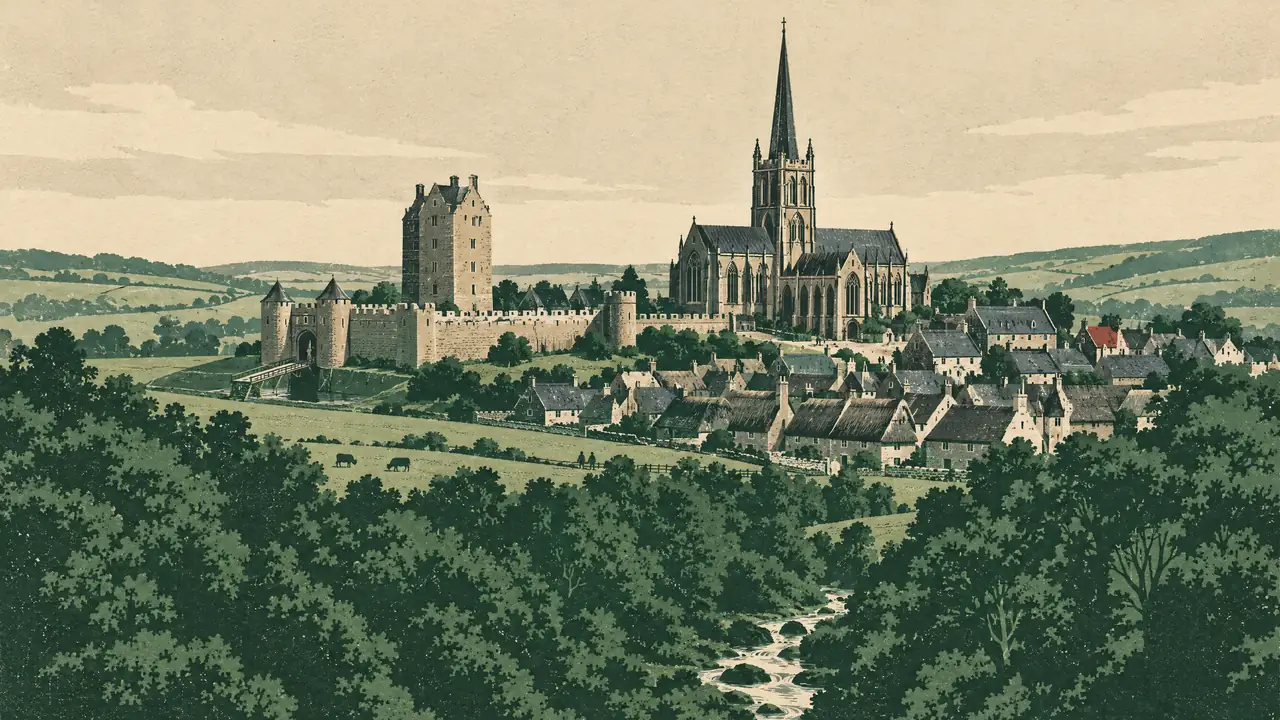
Visitors to Glasgow Cathedral today cross Cathedral Square without realising that they are walking over the site of a castle. For around six hundred years a fortified palace stood here, just west of the cathedral, as the residence of the bishops and later the archbishops of Glasgow. It was besieged and captured several times, changed hands repeatedly in the wars of the sixteenth century, and was finally pulled down in 1789 to make way for the Royal Infirmary. Only a single stone and a few buried foundations now remain.
The bishops’ stronghold
Medieval Glasgow was a church town. Its bishops were among the most powerful men in Scotland, lords of the burgh and of wide lands, and they needed a residence that matched their status and could be defended. The origins of the castle are uncertain, but there was probably a building on the site in the twelfth century, and it is recorded in a charter of 1258. Its position, on the high ground beside the cathedral and close to the steep valley of the Molendinar Burn, made it the natural stronghold of the town. More about the power of the medieval bishops is on our Glasgow bishopric page.
The Wars of Independence
The castle played its part in the wars against England at the end of the thirteenth century. In 1296 Edward I occupied Scotland and English forces held the castle. According to the later tradition preserved by the poet Blind Harry, William Wallace attacked the English garrison in Glasgow, an episode remembered as the fight at the Bell o’ the Brae on the High Street. The story cannot be confirmed from contemporary records, but it shows how closely the castle was bound up with the town’s sense of its own history. In 1301 the castle was again garrisoned for Edward I. The bishop of the time, Robert Wishart, was one of the leading supporters of Wallace and Robert the Bruce.
A palace grows
In the fifteenth century the castle was greatly enlarged. Bishop John Cameron built a five-storey tower house, or keep, which became the heart of the complex and the residence known as the Bishop’s Palace. Glasgow became an archbishopric in 1492, and its archbishops continued to add to the building. Archbishop James Beaton added a large corner tower and enclosed the whole site within a strong stone wall with battlements and bastions. Archbishop Gavin Dunbar built a gatehouse with round towers at the south-east corner between 1524 and 1547. Surrounded by a ditch and entered by a drawbridge, the castle was by then a formidable building.
Sieges and the Reformation
The sixteenth century brought repeated conflict. Scotland was divided by rivalries among the nobility, by the struggle between supporters of the alliance with France and those who favoured England, and by the religious upheaval of the Reformation. Between 1513 and 1570 the castle changed hands six times. In 1544 it was defended against the Regent Arran and Cardinal David Beaton, and at one point it was occupied by French troops. In 1560 it was held for Arran.
The Reformation of 1560 changed everything. The last Catholic archbishop, James Beaton, a member of the same powerful family, fled to Paris, taking many of the cathedral’s treasures and records with him. Bishops returned to the Church of Scotland at various times in the following century, and the castle remained their residence, but its importance faded. The struggles around Mary, Queen of Scots, which came to a head at the Battle of Langside in 1568, were among the last occasions when the town’s defences mattered.
Decline
By the seventeenth century the castle was falling into disrepair. Archbishop Arthur Ross attempted repairs in the 1680s, but after the revolution of 1688 to 1689 bishops were abolished in the Church of Scotland and the castle passed to the Crown. It was no longer anyone’s home. During the eighteenth century it decayed further, and from 1755 it was used as a quarry, its stone carted away for building elsewhere in the growing town.
In 1789 the remaining ruins were cleared to make way for the Glasgow Royal Infirmary, whose first building, designed by Robert and James Adam, opened on the site in 1794. The infirmary has since been rebuilt, and the castle disappeared from the landscape completely.
What survives
Almost nothing of the castle can be seen today. Excavations in the 1980s, before the building of the St Mungo Museum of Religious Life and Art, uncovered parts of its foundations. The museum itself, designed by the architect Ian Begg and opened in 1993, was built in a style intended to recall the lost castle. In Cathedral Square, a stone from the castle with a modern plaque marks the approximate position of the keep.
To get a sense of the medieval town that surrounded the castle, visitors can step into Provand’s Lordship, across the street, which was built in 1471 as part of a hospital founded by a bishop of Glasgow and is now the oldest house in the city. Between the cathedral, the museum and the old house, the bishops’ quarter of medieval Glasgow can still be imagined.
Timeline
| Date | Event |
|---|---|
| 12th century | A bishop’s residence probably stands on the site |
| 1258 | The castle is recorded in a charter |
| 1296 to 1301 | English garrisons hold the castle during the Wars of Independence |
| 15th century | Bishop John Cameron builds a five-storey keep |
| 1492 | Glasgow becomes an archbishopric |
| 1524 to 1547 | Archbishop Gavin Dunbar builds a new gatehouse |
| 1513 to 1570 | The castle changes hands six times |
| 1689 | Bishops are abolished; the castle passes to the Crown |
| From 1755 | The ruins are used as a quarry |
| 1789 | The site is cleared for the Royal Infirmary |
| 1993 | The St Mungo Museum opens beside the site |
Related questions
Did Glasgow have a castle?
Yes. The Bishop’s Castle, also called Glasgow Castle, stood just west of the cathedral, where Cathedral Square is now, from the medieval period until 1789.
Who lived in the Bishop’s Castle?
It was the residence of the bishops and, from 1492, the archbishops of Glasgow, until bishops were abolished in the Church of Scotland in 1689.
What happened to the Bishop’s Castle?
It fell into ruin, was used as a quarry from 1755 and was cleared in 1789 to make way for the Glasgow Royal Infirmary.
Can you see the Bishop’s Castle today?
Only a marker stone in Cathedral Square survives above ground. Foundations were found when the St Mungo Museum was built, and the museum’s design recalls the castle.