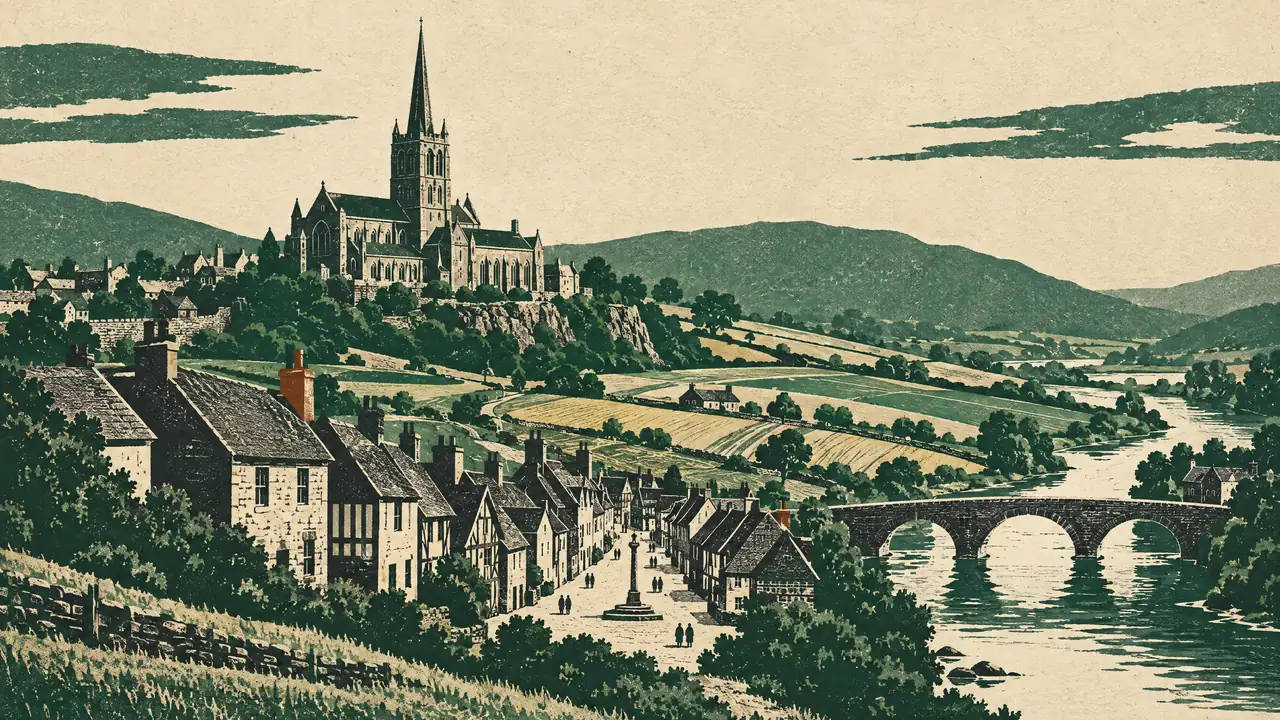
For most of the Middle Ages Glasgow was a church town first and a trading town second, and its fortunes rose with its bishops. Bishop John’s cathedral was dedicated in 1136 in the presence of King David I, and from then on the see of Glasgow was one of the wealthiest and most powerful in Scotland. The growth of the bishopric follows that rise, which ended with Glasgow becoming an archbishopric in 1492, with Galloway, Argyll and the Isles among its suffragan sees.
The bishops also made the town. Around 1175 Bishop Jocelin obtained a charter from King William the Lion that turned the cathedral village into a burgh with the right to hold a weekly market, and about 1190 a further grant allowed an annual fair, the ancestor of the Glasgow Fair holiday that is still marked every July. Glasgow becomes a burgh traces how the bishop’s little town slowly caught up with the royal burghs around it. In 1451 a papal bull founded the university, the second oldest in Scotland, giving the town a seat of learning that would later help to reshape the modern world.
The town itself was small. A couple of thousand people lived along a single spine running from the cathedral down the High Street to the Cross and on to the river, with gates, or ports, at its entrances rather than a defensive wall. Life in medieval Glasgow describes the markets, crofts, plague and fire of that world. Very little of it survives above ground, which makes the two great exceptions all the more precious: Glasgow Cathedral, the most complete medieval cathedral on the Scottish mainland, and Provand’s Lordship, built in 1471 by Bishop Andrew Muirhead as part of St Nicholas’s Hospital and now the oldest house in the city.
Begin with the burgh charter for the story of how the town was made, or with the cathedral for nine centuries of the city’s greatest building.
Explore further with the Glasgow Fair, granted in about 1190 and still remembered every July, the lost Bishop’s Castle that stood beside the cathedral for six centuries, Bishop Robert Wishart, ally of Wallace and Bruce, and Bishop Rae’s bridge, for four hundred years the only crossing of the Clyde at Glasgow.
Every article in this chapter: