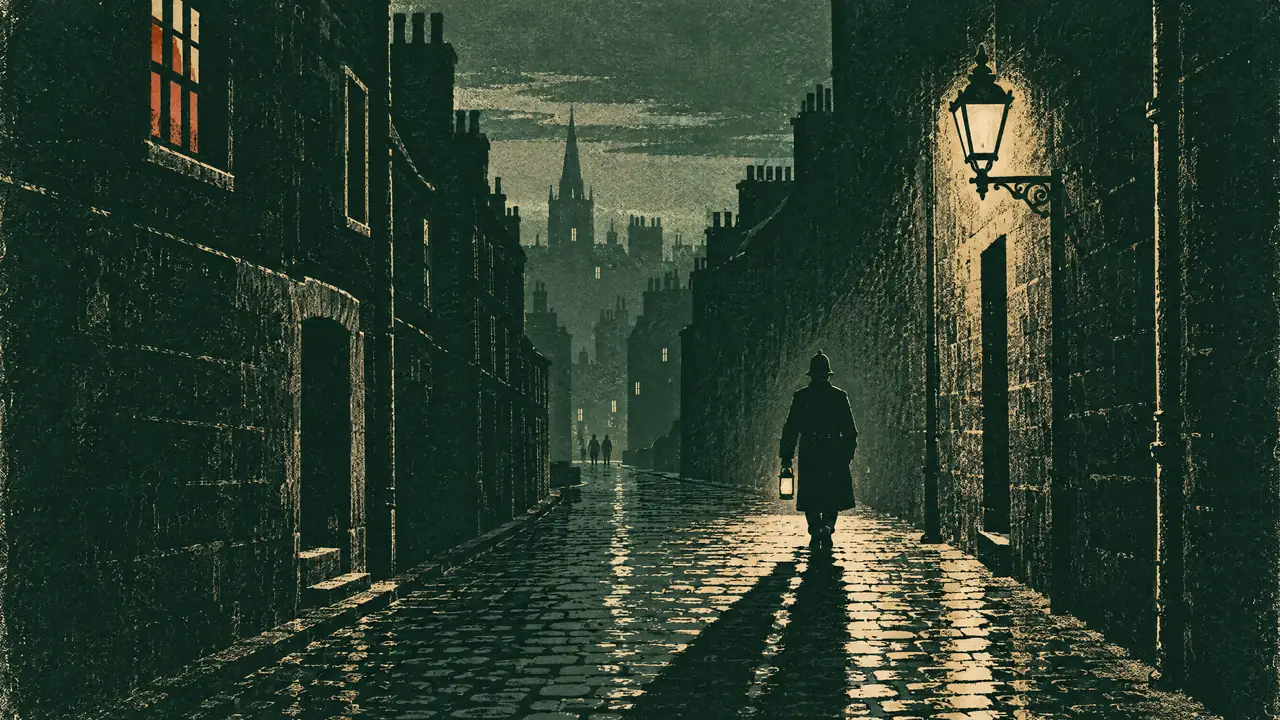
Glasgow’s history of crime and policing is longer, and more surprising, than its hard-man reputation suggests. The city created one of Britain’s first modern police forces: the City of Glasgow Police was established under an Act of 1800, nearly three decades before London’s Metropolitan Police, and served the city until it was merged into Strathclyde Police in 1975. The Sheriff Court, Duke Street Prison and Barlinnie, opened in 1882, complete the machinery of justice, and Sir Percy Sillitoe, chief constable from 1931 to 1943, gave the world’s police the chequered cap band.
Some of the city’s cases became famous far beyond Scotland. In the early nineteenth century the body snatchers raided Glasgow’s graveyards for the anatomy schools. Between 1857 and 1908 four notorious cases unfolded within a square mile of the west end: the trial of Madeleine Smith, the Sandyford Place murder, the poisonings of Dr Edward Pritchard and the murder that led to the wrongful conviction of Oscar Slater, who spent more than eighteen years in prison before his conviction was quashed in 1928.
The twentieth century brought Peter Manuel, hanged at Barlinnie in 1958, the unsolved murders attributed to Bible John, and one strange episode in which nobody was hurt at all: the hunt for the Gorbals Vampire in 1954. Gang culture has its own long history, from the razor gangs of the 1920s and 1930s to the Calton Tongs, the Ice Cream Wars and the world of Arthur Thompson and Paul Ferris. Glasgow’s most famous crimes is a guide to all of these cases.
The story does not end in violence. In 2005 Strathclyde Police set up the Violence Reduction Unit, which treated violence as a public health problem rather than simply a matter for enforcement. Its approach has been studied around the world, and it is part of the reason the city that was once labelled the murder capital of Europe now tells a different story. Throughout this chapter the victims come first, and what was never proven is never asserted as fact.
Other stories in this chapter reach from the Radical War of 1820, when the weaver James Wilson was hanged and beheaded in Glasgow for treason, to Susan Newell, the last woman executed in Scotland, and to the armed robbers of Walter Norval's XYY gang. Jimmy Boyle's journey from the Gorbals to the Barlinnie Special Unit is told here too, and the Glasgow Police Museum in the Merchant City is the place to see the history of the city’s police for yourself.
The chapter now reaches back to the Shawfield Riot of 1725, when Glasgow rose against the malt tax, and to the night in 1793 when the Hellfire Club burned down the Tron Kirk. It covers the cotton spinners’ trial of 1838, the fraud behind the City of Glasgow Bank crash and the Glasgow-born poisoner Thomas Neill Cream, along with three centuries of hangings in Glasgow. From the twentieth century come the disputed case of Peter Queen, the wartime safebreaker Johnny Ramensky, the wrongful conviction of Paddy Meehan, the defence lawyer Joseph Beltrami and the Barlinnie Special Unit. The story ends with how the city cut violence through the Violence Reduction Unit.
Every article in this chapter:
- Glasgow’s Most Famous CrimesRead →
- The Shawfield Riot of 1725Read →
- The Hellfire Club and the Tron Kirk FireRead →
- Glasgow’s Body SnatchersRead →
- The Radical War of 1820Read →
- The Glasgow Cotton Spinners’ TrialRead →
- Madeleine SmithRead →
- The Sandyford Place MurderRead →
- Dr Edward PritchardRead →
- The City of Glasgow Bank CollapseRead →
- Thomas Neill CreamRead →
- Oscar Slater CaseRead →
- Duke Street PrisonRead →
- Susan NewellRead →
- The Glasgow Razor GangsRead →
- Sir Percy SillitoeRead →
- Peter Queen and Chrissie GallRead →
- Johnny RamenskyRead →
- The Gorbals VampireRead →
- Peter ManuelRead →
- The Bible John MurdersRead →
- The Calton TongsRead →
- Paddy MeehanRead →
- Walter NorvalRead →
- Jimmy BoyleRead →
- The Barlinnie Special UnitRead →
- The Ice Cream WarsRead →
- Arthur ThompsonRead →
- Paul FerrisRead →
- Joseph BeltramiRead →
- From Murder Capital to the Violence Reduction UnitRead →
- Hangings in GlasgowRead →
- Glasgow’s Victorian Police ForceRead →
- The Glasgow Police MuseumRead →
- The History of Glasgow Sheriff CourtRead →
- Barlinnie PrisonRead →