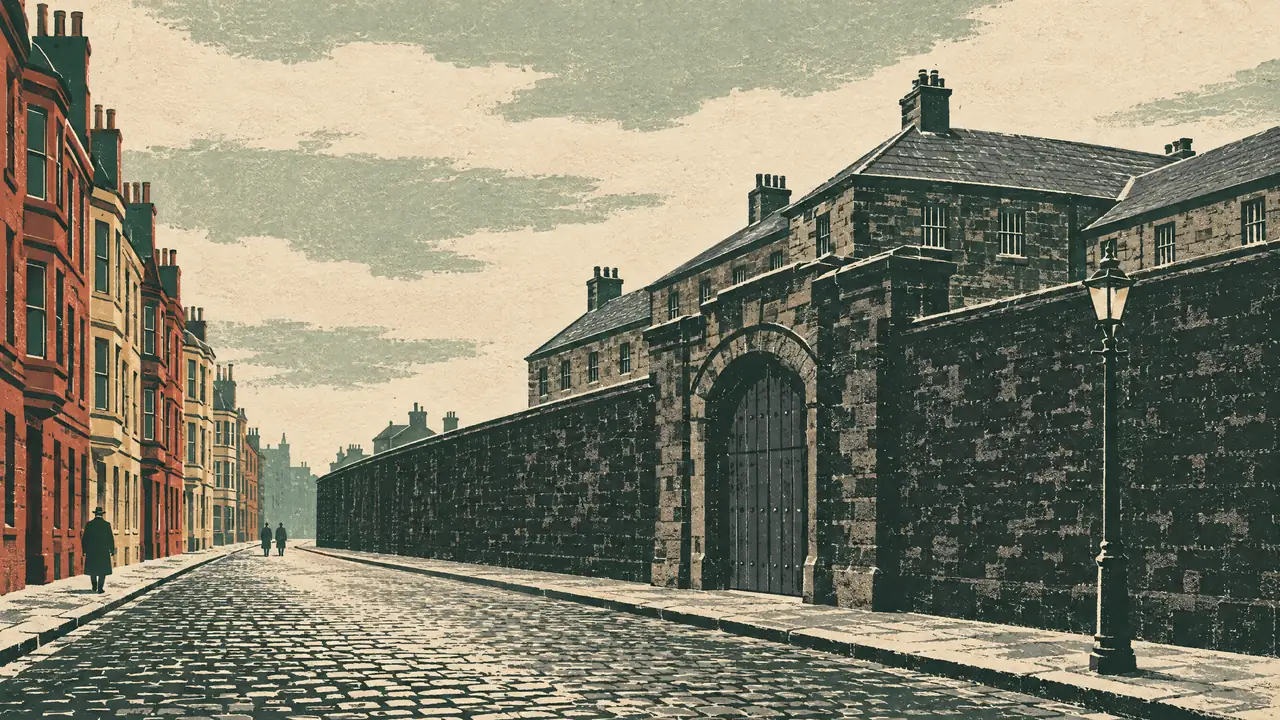
For more than 150 years a high stone wall on Duke Street, in the East End of Glasgow, enclosed the city’s main prison. Known at various times as the Bridewell, the North Prison and simply Duke Street, it held debtors, thieves, drunks and murderers, then from the 1880s became Scotland’s principal prison for women. Suffragettes went on hunger strike in its cells, and twelve people were hanged within its walls. It closed in 1955 and was demolished soon afterwards, and today almost nothing of it survives except a stretch of the boundary wall beside the Ladywell housing that replaced it.
Glasgow’s prisons before Duke Street
For centuries the town’s jail was the Tolbooth at Glasgow Cross, where debtors, felons and political prisoners were crowded into a few rooms beside the council chambers. As Glasgow grew in the eighteenth century the Tolbooth became hopelessly inadequate. New ideas about punishment were also spreading: reformers argued that prisoners should be set to work, kept apart from each other and corrected rather than simply confined. Glasgow responded with a house of correction, or bridewell, and in 1798 the new Bridewell on Duke Street received its first inmates.
A model prison
Duke Street was an early example in Scotland of what became known as the separate system, in which prisoners were held in individual cells and kept apart from one another, the idea being to prevent hardened offenders from corrupting the young and to encourage reflection. It was expanded several times in the nineteenth century, and in 1841 an official report described it as the only well managed prison in Scotland.
Legislation from 1839 onwards brought Scotland’s prisons under central control and closed many small local jails. Between 1839 and 1862 Glasgow’s other prisons were closed one by one, until Duke Street was the only one left in the city. It held men and women serving short sentences, prisoners awaiting trial and those condemned at the High Court. In 1865 the poisoner Dr Edward Pritchard was held in the North Prison while awaiting his trial.
A prison for women
Further reforms in 1860 and 1877 placed Scottish prisons under the control of the state and led to the building of larger institutions. When Barlinnie opened in 1882 on the city’s north-eastern edge, male prisoners were gradually moved there, and Duke Street became a prison for women, the role it kept until it closed. Women from across the west of Scotland served their sentences there, most of them for offences rooted in poverty and drink. In 1946 it became the first women’s prison in Scotland to be run by a woman, when the Hon. Victoria Bruce was appointed governor.
The suffragettes
In the years before the First World War, Duke Street held many of the women arrested in the campaign for the vote. On 24 July 1913 Ethel Moorhead and Dorothea Chalmers Smith were caught trying to set fire to an empty house at 6 Park Gardens in the west end and taken to Duke Street. Moorhead, who gave a false name, smashed her cell windows, and both women went on hunger strike. They were released under the so-called Cat and Mouse Act, which allowed hunger strikers to be freed until they recovered and then rearrested. Sentenced to eight months in October 1913, they went back to Duke Street, struck again and were released once more, and both failed to return.
In March 1914 Helen Crawfurd was jailed at Duke Street for breaking windows at the army recruiting office on the Gallowgate in protest at the arrest of Emmeline Pankhurst. She too went on hunger strike and was released and rearrested. Members of the Women’s Social and Political Union picketed the prison gates day and night, and on 16 March 1914 the suffragette Jean Lambie struck the prison commissioner, Dr James Devon, with a horsewhip as he arrived at the prison, then addressed the crowd outside about force-feeding. A cast iron umbrella stand from the prison, decorated in suffragette colours by women held there, is now in the collection of the Glasgow Women’s Library. The wider story is told on our women’s suffrage in Glasgow page.
Daily life inside
For most of the people who passed through Duke Street, prison meant a short sentence for a minor offence: drunkenness, petty theft, breach of the peace or failure to pay a fine. Many were caught in a revolving door, released and returned again and again. Life inside followed the strict routines of the Victorian prison system, with long hours alone in the cell, silence, plain food and hard, repetitive work such as picking oakum, the unpicking of old ropes into fibres.
As a women’s prison from the 1880s, Duke Street held many women whose offences were rooted in poverty, drink and the hardships of tenement life, and some who had their babies with them. Reformers, chaplains and visitors worked to help prisoners on their release, but conditions remained grim, and by the twentieth century the old buildings were widely regarded as unfit for purpose.
The gallows
After public executions ended, condemned prisoners in Glasgow were hanged inside prison walls. Between 1902 and 1928 twelve people were executed at Duke Street, all of them convicted of murder. The most remembered is Susan Newell, hanged on 10 October 1923 for the murder of John Johnston, a thirteen-year-old newspaper boy from Coatbridge. The jury had recommended mercy and a petition asked for her sentence to be reduced, but the Secretary of State for Scotland refused to intervene. She was the last woman to be executed in Scotland. After Duke Street’s gallows fell out of use, executions in Glasgow moved to Barlinnie.
The case of Susan Newell
The case that made Duke Street’s gallows notorious began in Coatbridge in June 1923. John Johnston, a thirteen-year-old newspaper boy, disappeared while selling papers, and the next day Susan Newell and her young daughter were seen pushing a heavy bundle on a go-cart along the road to Glasgow. A lorry driver gave them a lift into the city and set them down on Duke Street itself, where suspicious local people called the police. Newell was seen leaving the bundle in a back court, and the boy’s body was found inside.
At her trial at the High Court in Glasgow in September 1923 before Lord Alness, her daughter gave evidence against her, and a plea of insanity was rejected. The jury found her guilty by a majority but strongly recommended mercy. The recommendation was ignored, and she was hanged at Duke Street on 10 October 1923, the first woman executed in Glasgow for many decades and the last in Scotland.
Closure and Ladywell
By the twentieth century the old prison was overcrowded, cold and widely condemned. Conditions there became the subject of a Glasgow street song sung to the tune of the hymn There Is a Happy Land, and campaigners kept up pressure for its closure. Among them was the nationalist Wendy Wood, who had served sixty days there for refusing to pay National Insurance contributions and afterwards became a determined campaigner for prison reform.
Duke Street closed in 1955 and the buildings were demolished in 1958. Between 1961 and 1964 the Ladywell housing scheme was built on the site, close to the Necropolis and the old heart of the city around the cathedral. A section of the prison’s boundary wall still stands, and photographs taken in 1955 by members of Glasgow camera clubs, now in the collections of Glasgow Museums, record what the prison looked like in its final days.
Timeline
| Date | Event |
|---|---|
| 1798 | The Bridewell on Duke Street receives its first prisoners |
| 1841 | An official report calls it the only well managed prison in Scotland |
| 1839 to 1862 | Glasgow’s other prisons close, leaving Duke Street |
| 1865 | Dr Pritchard is held in the North Prison before his trial |
| 1882 onwards | Men move to Barlinnie; Duke Street becomes a women’s prison |
| 1902 | The first execution inside Duke Street takes place |
| 1913 to 1914 | Suffragettes are imprisoned and go on hunger strike |
| 10 Oct 1923 | Susan Newell is hanged, the last woman executed in Scotland |
| 1928 | The last execution at Duke Street |
| 1946 | Victoria Bruce becomes the first woman governor |
| 1955 | The prison closes |
| 1958 | The buildings are demolished |
| 1961 to 1964 | The Ladywell housing scheme is built on the site |
Related questions
When did Duke Street Prison open and close?
It received its first prisoners in 1798 and closed in 1955. The buildings were demolished in 1958.
Who was executed at Duke Street Prison?
Twelve people convicted of murder were hanged there between 1902 and 1928, including Susan Newell in 1923, the last woman executed in Scotland.
Were suffragettes held in Duke Street Prison?
Yes. Ethel Moorhead, Dorothea Chalmers Smith and Helen Crawfurd were among the suffragettes held there in 1913 and 1914, and several went on hunger strike.
What is on the site of Duke Street Prison now?
The Ladywell housing scheme, built between 1961 and 1964. Part of the old prison boundary wall survives.