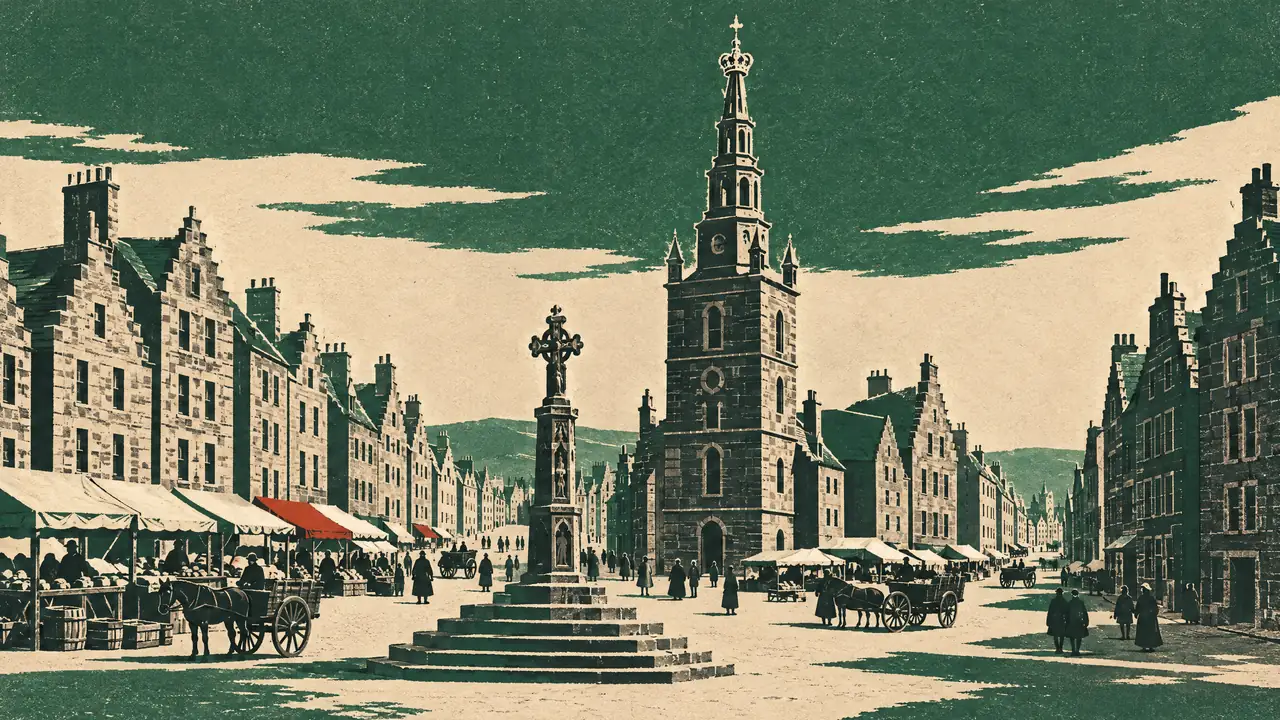
Glasgow Cross is where the old town did its living. Here the High Street, coming down from the cathedral, met the Trongate running west, the Saltmarket running south to the river and the Gallowgate heading east, joined in the nineteenth century by London Road. At the meeting stood everything a Scottish burgh needed: the mercat cross, where trade was licensed and proclamations read, and the Tolbooth, which was council chamber, courthouse and jail in one. For centuries this crossroads was the centre of Glasgow, and the junction still marks the boundary between the city centre and the East End.
The burgh’s market place
Glasgow became a burgh around 1175, under a charter obtained by Bishop Jocelin from King William the Lion, and a market cross was likely among the first things the new burgh set up. The early cross stood beside the Tolbooth where the four ancient streets met. Life in the medieval town was organised around this spot: markets were held here, burgesses traded under the eye of the town’s officers, and royal proclamations were read aloud to the crowd. A few steps west, the tron, the public weighing beam, gave its name to the Trongate, while the High Street climbed north to Glasgow Cathedral and the bishops’ quarter.
The streets were lined with tall stone tenements with timber galleries. In June 1652 a great fire destroyed the timber frontages in all four streets, and the council ordered new houses to be built of stone, with arcades at street level. Visitors admired the result. Daniel Defoe, touring Scotland in the 1720s, found the streets of Glasgow the fairest and most regular he had seen.
The Tolbooth
A tolbooth stood at the Cross by the fourteenth century. Its successor was begun in 1626 to the designs of John Boyd, the town’s master of works, and completed in 1634: a five-storey main block with a seven-stage tower at its east end, 126 feet high and crowned with an open stone crown spire. It was the seat of the town council, a courthouse and a prison. Covenanters, among them the preacher Donald Cargill, were held there, and in 1706 rioters protesting against the Union seized muskets from its armoury. Twenty-two executions took place at the Tolbooth in the seventeenth and eighteenth centuries, part of the long story told on the page on Glasgow’s hangings.
In 1814 the council, courts and jail moved to new buildings in the Saltmarket facing Glasgow Green, and the Tolbooth was sold. Its main block was remodelled and served as a warehouse and offices until 1921, when it was demolished. Only the steeple was left. Repaired in 1923, it is listed at Category A by Historic Environment Scotland as the only surviving fragment of the Tolbooth, and it now stands alone on an island in the traffic.
Merchants on the plainstanes
In the eighteenth century the Cross was the heart of the tobacco city. Beside the Tolbooth rose the Town Hall, designed by Allan Dreghorn from 1737, with an arcaded piazza whose keystones were carved with grotesque faces. In 1781 the building was taken over by the Tontine Society and became the Tontine Hotel and coffee room, where merchants read the shipping news; several of the carved Tontine Heads survive and can be seen at Provand’s Lordship. In front of it ran the plainstanes, a paved walk on which the tobacco lords were said to parade in scarlet cloaks and wigs, keeping the other classes at a respectful distance.
In 1735 an equestrian statue of King William III, paid for by the former governor of Madras James Macrae, was set up in front of the Tontine. It was moved in 1897 because it obstructed traffic, and in 1926 it was moved again to Cathedral Square, where it stands today.
Proclamations and crowds
Because it was the centre of the burgh, the Cross was where Glasgow gathered. Kings were proclaimed here, celebrations held and riots begun. In December 1745, during the Jacobite occupation of the city, the exiled James Stuart was proclaimed King James VIII at the Cross, to a distinctly cool reception, as told on the page on Glasgow and the 1745 rising.
The mercat cross
The original mercat cross was removed in 1659. For nearly three centuries the burgh had no cross at all, until William George Black and his wife paid for a new one. Designed by Edith Burnet Hughes, generally regarded as Britain’s first practising woman architect, it takes the form of an octagonal tower from which rises a shaft topped by a heraldic unicorn. It was built in 1929 and inaugurated with great ceremony on 24 April 1930. It is a replica of a lost original rather than a medieval survivor.
The Cross today
Glasgow’s centre of gravity long ago moved west, and the twentieth century took much from the Cross. Glasgow Cross railway station, opened beneath the junction in 1895, closed in 1964, and the buildings that once pressed around the Tolbooth have mostly gone. Yet the geography of the old town still reads at a glance. Uphill lies the cathedral, downhill the river and Glasgow Green, west the Trongate and the Merchant City, and east the Gallowgate, whose name is traditionally linked with the road out to the burgh’s gallows.
Timeline
| Date | Event |
|---|---|
| About 1175 | Glasgow becomes a burgh; a market cross is likely set up |
| 14th century | A tolbooth stands at the Cross |
| 1626 to 1634 | New Tolbooth built to designs by John Boyd |
| June 1652 | Great fire destroys the timber frontages of the four streets |
| 1659 | Original mercat cross removed |
| 1735 | Statue of William III set up in front of the Town Hall |
| 1737 | Allan Dreghorn designs the Town Hall, later the Tontine |
| December 1745 | James VIII proclaimed at the Cross by the Jacobites |
| 1814 | Council, courts and jail move to the Saltmarket |
| 1895 | Glasgow Cross railway station opens |
| 1921 | Tolbooth demolished; only the steeple survives |
| 24 April 1930 | New mercat cross by Edith Burnet Hughes inaugurated |
Related questions
Which streets meet at Glasgow Cross?
The High Street, Trongate, Saltmarket, Gallowgate and London Road. The first four are the ancient streets of the burgh; London Road was added in the nineteenth century.
How old is the Tolbooth Steeple?
It was built between 1626 and 1634 to designs by John Boyd. The rest of the Tolbooth was demolished in 1921, leaving the steeple standing alone.
Is the mercat cross original?
No. The original was removed in 1659. The present cross is a replica designed by Edith Burnet Hughes, built in 1929 and inaugurated in 1930.
Were people executed at Glasgow Cross?
Yes. Twenty-two executions took place at the Tolbooth in the seventeenth and eighteenth centuries, before hangings moved to the Saltmarket after 1814.