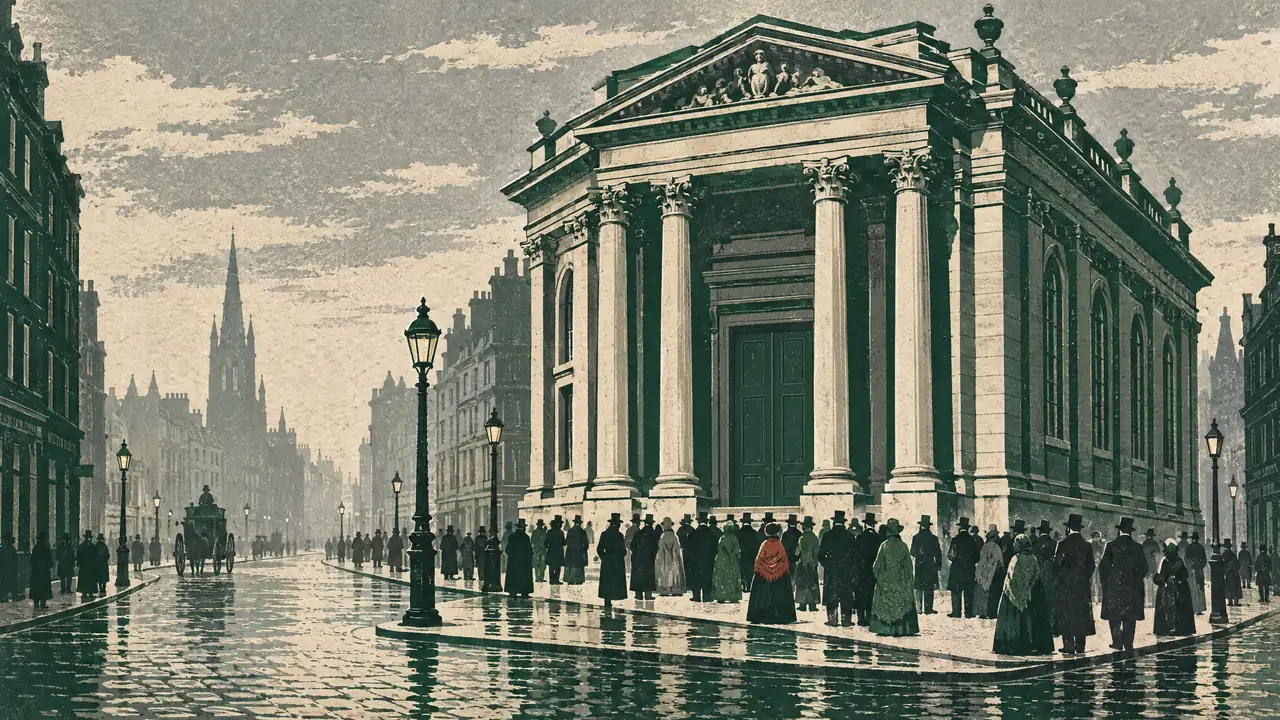
On 2 October 1878 the City of Glasgow Bank closed its doors and never opened them again. It was one of the largest banks in Britain, with a branch network spread across Scotland, and its failure was one of the great financial disasters of the Victorian age. When investigators opened the books, they found not bad luck but fraud: false figures, hidden losses and secret dealings designed to keep up the appearance of a healthy bank. The directors went to prison, and the shareholders, who were liable for every penny of the bank’s debts, were ruined.
A bank for small savers
The City of Glasgow Bank was founded in 1839, part of a wave of new Scottish banks in the years after 1825. From the start it set out to serve ordinary savers, and some of its branches opened in the evenings so that working people could pay in money after their day’s work. Its head office moved from Virginia Street to Glassford Street and then, in 1855, to a large building on the Trongate at the corner of Albion Street.
The bank had a rocky passage. It was forced to suspend business in the financial panic of 1857, before reopening. By the 1870s it had grown into one of the largest branch networks in the United Kingdom, with 133 branches, and in June 1878 it announced deposits of about £8 million and a dividend of 12 per cent.
Unlimited liability
Like most banks of its time, the City of Glasgow Bank was owned by shareholders with unlimited liability. If the bank failed, they were personally responsible for all its debts, without limit. Its 1,200 or so shareholders included many ordinary investors who had bought shares as a safe holding paying a handsome dividend.
The collapse
Behind the reassuring figures, the bank was rotten. It had lent huge sums on poor security, and it had poured money into speculative ventures overseas, including land in Australia and New Zealand, mining shares and American railway stock. To hide the losses, false reports of its holdings of gold were made to the authorities, the balance sheets were falsified, and the bank secretly bought its own shares to keep their price high. So successful was the deception that on its last day of business its £100 shares were selling for £236.
When the bank closed on 2 October 1878, the examination of its affairs revealed net liabilities of more than £6 million, a colossal sum at the time.
The directors on trial
The directors and the manager were arrested and tried before the High Court in Edinburgh in January 1879. Sentence was passed on 1 February. The manager, Robert Stronach, and Lewis Potter, a director since the bank’s foundation, were found guilty of falsifying and fabricating the balance sheets and were each sentenced to eighteen months’ imprisonment. The other five directors were found guilty of issuing balance sheets they knew to be false and were sentenced to eight months.
The cost to Glasgow
Depositors and holders of the bank’s notes were protected, because other Scottish banks accepted its notes and the shareholders’ liability covered the deposits. The shareholders paid instead. Calls were made on them again and again to meet the bank’s debts, and all but 254 of the 1,200 were ruined. Scores of Glasgow businesses failed in the aftermath. A national relief fund was opened for the victims and had raised almost £380,000 by 1882.
The disaster shook the city’s confidence at the height of its Victorian prosperity, in the era when Glasgow called itself the Second City of the Empire.
What changed
The collapse turned opinion firmly towards limited liability for bank shareholders, and the Companies Act of 1879 made it possible for banks to limit their shareholders’ liability. The bank’s records are now held in the archives of the University of Glasgow. The crash also found its way into fiction, most memorably in Guy McCrone’s Glasgow trilogy Wax Fruit (1948).
The City of Glasgow Bank stands as Glasgow’s great white-collar crime, a reminder that some of the most damaging offences in the city’s history were committed not in the slums but in its boardrooms. More of the city’s notable cases are gathered in Glasgow’s famous crimes.
Timeline
| Date | Event |
|---|---|
| 1839 | Bank founded with branches aimed at small savers |
| 1855 | Head office moves to the Trongate at Albion Street |
| 1857 | Business suspended in the financial panic, later resumed |
| June 1878 | Bank reports 133 branches, deposits of £8 million and a 12 per cent dividend |
| 2 October 1878 | Bank closes; losses of over £6 million revealed |
| January 1879 | Directors tried at the High Court in Edinburgh |
| 1 February 1879 | Two sentenced to eighteen months, five to eight months |
| 1882 | Relief fund for shareholders passes £379,000 |
Related questions
Why did the City of Glasgow Bank collapse?
It had lent heavily on poor security and invested in risky overseas ventures, and it hid the losses with falsified accounts and secret purchases of its own shares.
What happened to the directors?
At the High Court in Edinburgh in 1879 the manager and one director received eighteen months in prison, and five other directors received eight months.
Who lost money?
The shareholders, who had unlimited liability. All but 254 of about 1,200 were ruined. Depositors and noteholders were protected.
What changed afterwards?
The disaster strengthened the case for limited liability for bank shareholders, and the Companies Act of 1879 allowed banks to adopt it.