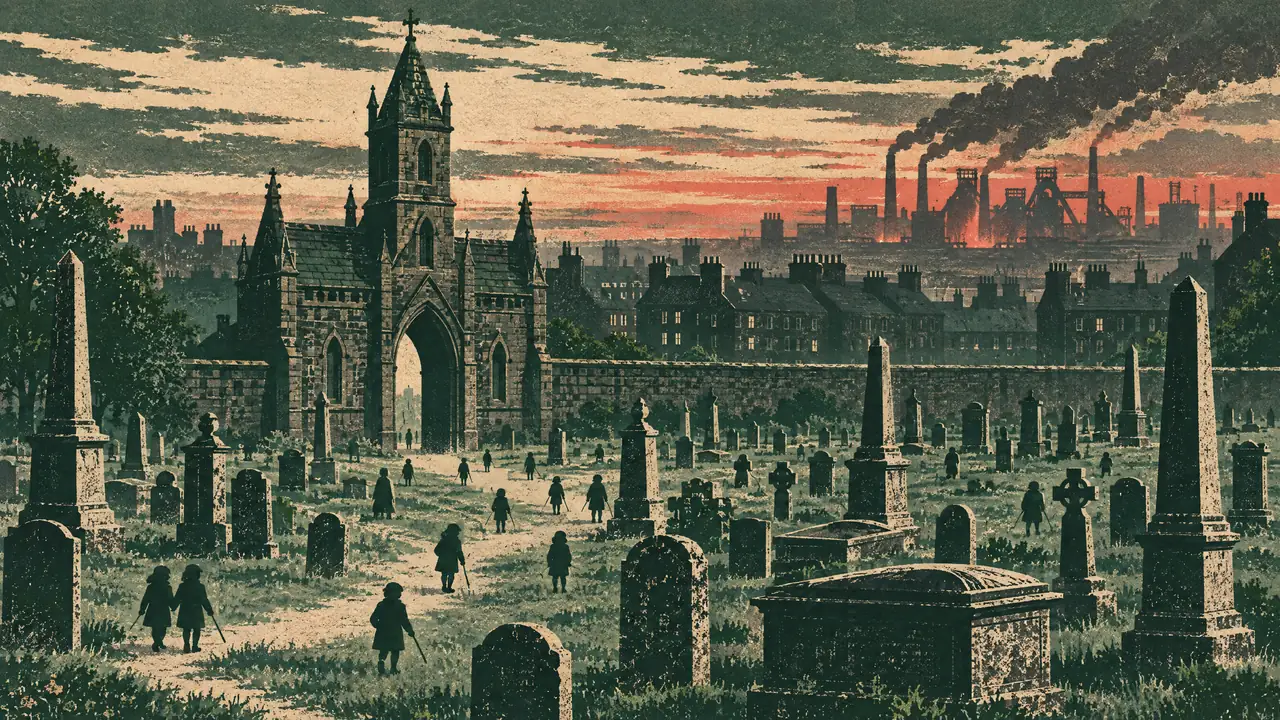
On the afternoon of Thursday 23 September 1954, as the schools of the Gorbals and Hutchesontown emptied for the day, hundreds of children marched on the Southern Necropolis. Some carried sticks and stones, others sharpened stakes and kitchen knives. They had come to kill a vampire: a creature seven feet tall with iron teeth, which was said to live among the graves and to have already killed and eaten two local boys. No such boys were missing, and there was no vampire. But the hunt went on for several nights, made headlines across Britain and helped to change the law.
The Southern Necropolis
The Southern Necropolis on Caledonia Road opened in 1840 to give the people of the Gorbals an affordable and respectable place of burial, after the old Gorbals burial ground had become dangerously overcrowded. It grew to three sections, entered through a grand gatehouse designed by the architect Charles Wilson in 1848, and more than a quarter of a million people are buried there, among them the tea merchant Sir Thomas Lipton and the architect Alexander Greek Thomson.
In the 1950s it was surrounded by some of the most crowded tenement streets in Europe. For the children of the Gorbals, with few parks and little space at home, the cemetery’s walls, paths and tombs were both a playground and a place of dares and ghost stories. Nearby, the furnaces of the ironworks known as Dixon’s Blazes lit up the night sky with a red glow and filled the air with smoke.
Glasgow in 1954
The vampire hunt took place in a city that was crowded, poor and on the brink of enormous change. The Gorbals was among the most densely populated districts in Britain, its tenements divided into single rooms and room-and-kitchen flats where large families shared toilets on the stairs. Within a few years the great clearances that would sweep most of those tenements away were under way, as described on our Gorbals redevelopment page.
Children in the district had few organised activities and little supervision outside school hours. They played in back courts, on the streets and in any open space they could find, and they passed stories among themselves at speed. It was an ideal setting for a rumour to spread from one playground to the next, gathering detail as it went, until hundreds of children were convinced that something terrible was waiting among the graves.
The hunt
The rumour seems to have spread through local playgrounds over several days. By the time school ended that Thursday, it had turned into a plan. Children of all ages, from infants barely able to walk to teenagers of fourteen, gathered and set off together, collecting more recruits as they went. They climbed the walls or poured through the gates and swarmed among the graves, searching every corner for the monster.
The cemetery staff could do nothing with them, and the police were called. A local constable, Alex Deeprose, went in to find out what was happening and was told solemnly about the vampire and the boys it had eaten. The crowd was eventually cleared, but bands of children lingered outside the walls until darkness fell. The next evening they were back, more than a hundred of them climbing the high walls once again, while gravediggers helped the keepers try to hold the gates. A reporter from a national newspaper walking among them found children clinging to his coat and begging him to shoot the vampire so that they could sleep at night.
The hunts dwindled over the following days, helped, according to some memories, by rain. Interest faded as quickly as it had arisen. Years later, men and women who had joined the hunt as children remembered the excitement and the fear, and some admitted that they were not entirely sure what a vampire was.
Where did the vampire come from?
Adults wanted an explanation, and they quickly found one in the American horror comics then being sold in Britain, with titles such as Tales from the Crypt. Teachers, ministers and newspapers blamed them for filling children’s heads with monsters. One American comic published in 1953 had indeed carried a story called The Vampire with the Iron Teeth. But there was no evidence that any of the Gorbals children had read it, and many of them could hardly have afforded such comics.
Other sources lay closer to home. In the Book of Daniel, read in Scottish churches and schools, a terrible beast appears with great iron teeth. The Scottish poet Alexander Anderson’s poem Jenny wi’ the Airn Teeth, about a bogey who comes for children who will not go to sleep, was well known in Scottish classrooms. And the glare and noise of the ironworks above the cemetery gave the whole district something of a nightmare quality after dark. Folklorists have also pointed out that Glasgow had seen similar outbreaks before, with crowds of children hunting ghosts and banshees in earlier decades. The vampire was, in a sense, a very local creation.
Dixon’s Blazes
Part of the story’s power came from the landscape around it. Close to the cemetery stood the Govan Iron Works, founded by the Dixon family and known throughout Glasgow as Dixon’s Blazes because of the flames that roared from its blast furnaces day and night. For children living in its shadow, the red glare in the sky, the clang of metal and the drifting smoke made the area after dark feel like something from a story. Some people who remembered the hunt later linked the iron teeth of the vampire to the ironworks that dominated their world. The works closed in 1958, only four years after the hunt.
Not the first, nor the last
Glasgow’s children had gone monster hunting before. Newspapers in the 1930s reported crowds of children searching for ghosts and banshees in different parts of the city, and in later decades similar hunts were reported in Paisley and Kilmarnock. What made the 1954 hunt different was its size, the weapons the children carried and the moment at which it happened, at the height of a national argument about what children were reading.
From the playground to Westminster
The Gorbals Vampire became part of a growing moral panic about horror comics that was already under way in Britain and America. When Parliament debated a bill to restrict them in early 1955, the Glasgow MPs Alice Cullen, who represented the Gorbals, and John Rankin, of Tradeston, both raised the vampire hunt as evidence of the damage the comics could do. The Children and Young Persons (Harmful Publications) Act 1955 followed. It made it an offence to print, publish or sell comics likely to fall into children’s hands that portrayed crimes, violence, cruelty or incidents of a repulsive or horrible nature in a way that would tend to corrupt a young reader.
The Act was rarely used, and modern historians have generally concluded that the Gorbals children were driven less by comics than by an older mixture of rumour, scripture, poetry and the very real strangeness of a cemetery beside an ironworks. Yet the episode remains a striking example of how a playground story could reach the statute book.
Remembering the hunt
The vampire hunt has become one of the best loved stories of the south side. It has been the subject of radio documentaries, including one presented by the Glasgow novelist Louise Welsh, and of community theatre work at the Citizens Theatre, whose audiences included people who had joined the hunt as children. In 2016 a mural of the vampire by the artists Ella Bryson and Art Pistol was painted in an archway on St Luke’s Place, a short walk from the cemetery. It sits well alongside the other tales gathered on our Glasgow ghost stories page, with one important difference: this one is documented in the newspapers of the day, and nobody was hurt.
Timeline
| Date | Event |
|---|---|
| 1840 | The Southern Necropolis opens on Caledonia Road |
| 1953 | An American comic publishes a story called The Vampire with the Iron Teeth |
| 23 Sept 1954 | Hundreds of children hunt the vampire in the Southern Necropolis |
| 24 Sept 1954 | More than a hundred children return after dark |
| 25 Sept 1954 | The story is reported in the national press |
| Early 1955 | Glasgow MPs cite the hunt in the Commons debate on horror comics |
| 1955 | The Children and Young Persons (Harmful Publications) Act becomes law |
| 2010 | Louise Welsh presents a Radio 4 documentary on the hunt |
| 2016 | A mural of the vampire is painted on St Luke’s Place |
Related questions
What was the Gorbals Vampire?
An imaginary seven-foot vampire with iron teeth that local children believed was living in the Southern Necropolis in September 1954 and had eaten two local boys. Hundreds of children hunted it among the graves.
When did the Gorbals Vampire hunt happen?
It began on the afternoon of Thursday 23 September 1954 and was repeated on the following nights before the excitement faded.
Did the Gorbals Vampire change the law?
The hunt was cited in Parliament during the debate that led to the Children and Young Persons (Harmful Publications) Act 1955, which restricted the sale of horror comics to children.
Where is the Southern Necropolis?
On Caledonia Road in the Gorbals, on Glasgow’s south side. It opened in 1840 and more than 250,000 people are buried there.