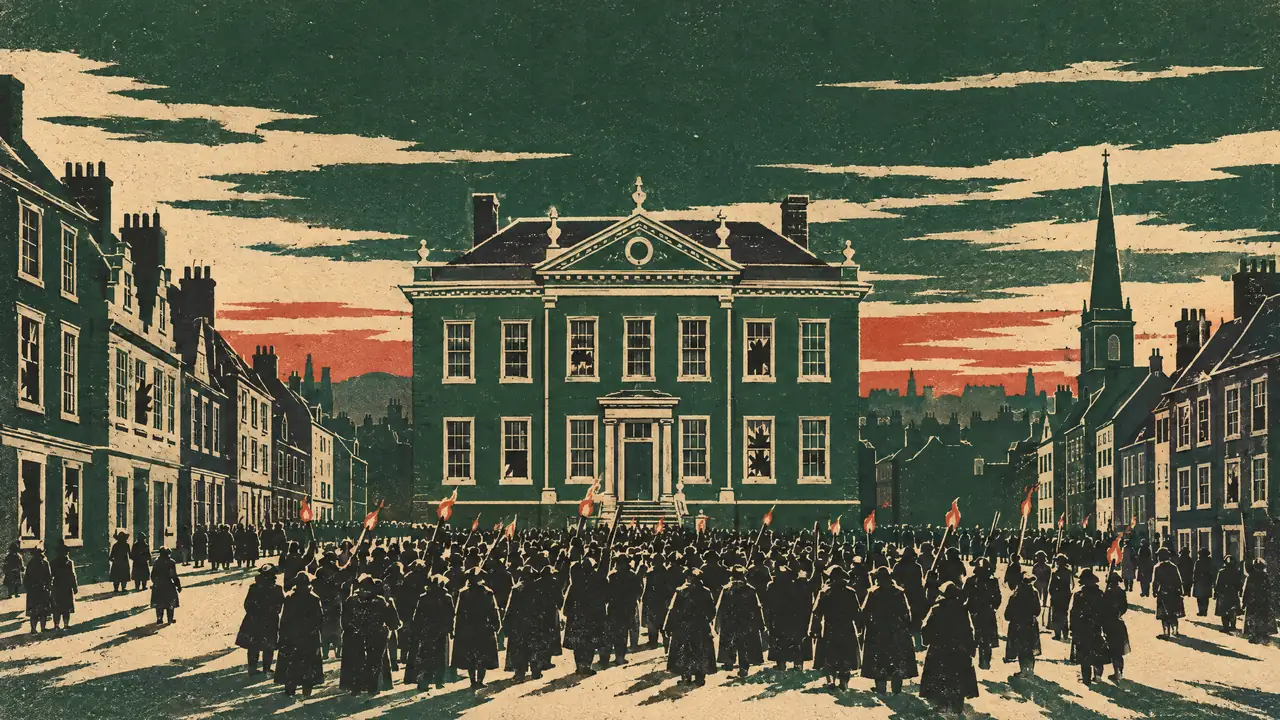
In the summer of 1725 Glasgow rose in fury against a tax on malt. Crowds took control of the streets, drove off the excise officers and wrecked the grand town house of the city’s member of parliament, Daniel Campbell of Shawfield, who had voted for the tax. Soldiers fired into the crowd and people died. In the end General Wade marched on Glasgow with a much larger force, the magistrates were arrested, and the city was made to pay. The Shawfield Riot was the fiercest of the malt tax riots that swept Scotland that year.
Why malt mattered
At the Union of 1707 Scotland was promised a temporary exemption from the English tax on malt, the sprouted barley used to brew ale. An attempt to extend the tax north in 1713 caused such anger that it helped bring a motion to dissolve the Union itself close to success. In 1725 the government in London tried again, this time setting the Scottish rate at half the English one. It still raised the price of ale. Ale was the everyday drink of most Scots, and a tax on malt was a tax on ale.
The protests began in Hamilton on 23 June 1725 and spread quickly to Edinburgh, Stirling, Dundee, Ayr, Elgin and Paisley. Nowhere was the anger greater than in Glasgow.
The riot
In late June crowds gathered in the centre of Glasgow and rang the town’s bell to summon support. They stopped the excise officers from collecting the tax, then turned on Daniel Campbell. Known as "Great Daniel" for both his size and his fortune, Campbell was a merchant who had grown rich in the tobacco and Atlantic trades, including the slave trade, and he had represented the Glasgow burghs in parliament since 1716. In 1711 he had built Shawfield Mansion, an elegant house at the head of what is now Glassford Street off the Trongate, said to be the finest in the city.
The crowd broke in and wrecked the house, smashing windows and destroying or carrying off its contents. Accounts differ on how much of the building was damaged, but the interior was left in ruins.
Shots in the street
Soldiers of Lord Deloraine’s regiment, under Captain Bushell, were called in. When they tried to restore order, they fired on the crowd, killing nine people and wounding many more, according to the account of the historian Ian R. Mitchell, who notes that the troops opened fire without the legal warning required. Far from ending the riot, the shootings enraged the city. The magistrates ordered the soldiers out of Glasgow, and the crowd pursued them as they withdrew towards Dumbarton.
Wade and the reckoning
The government responded with force. General George Wade, commander of the army in Scotland, marched on Glasgow with a large body of troops including cavalry, and Duncan Forbes of Culloden, the Lord Advocate, came with him to punish those responsible. Rioters were jailed, whipped, fined or transported. In a striking move, the provost and magistrates of Glasgow were themselves arrested, accused of favouring the mob. The charges against them were later dropped.
The city was made to compensate Campbell for his losses, a sum usually given as about £9,000. Ian Mitchell has argued that the figure was far higher than the real cost of repairs and served more as a reward for a loyal government supporter. Campbell used the money to buy the island of Islay, where his family went on to transform the island’s farming and, eventually, its whisky.
Shawfield Mansion afterwards
The mansion survived the riot and remained one of the finest houses in Glasgow. In the winter of 1745 to 1746 it became the headquarters of Bonnie Prince Charlie during his stay in the city on the retreat from England. It was demolished in 1792. Campbell’s family name lives on in the Shawfield district near Rutherglen, where his country estate lay.
Legacy
The malt tax riots forced the government to pay more attention to Scottish grievances. The Lord Advocate who had opposed the tax, Robert Dundas, lost his post, and in 1727 the government set up the Board of Trustees for Manufactures and Fisheries to promote Scottish industry. The riot sits early in a long tradition of Glasgow crowds taking to the streets, from the Calton weavers of 1787 to the Radical War of 1820, and it belongs to the city of the Tobacco Lords, whose trade made Campbell’s fortune.
Timeline
| Date | Event |
|---|---|
| 1707 | Union of the Parliaments; Scotland temporarily exempted from the malt tax |
| 1711 | Daniel Campbell builds Shawfield Mansion |
| 1713 | First attempt to extend the malt tax to Scotland abandoned |
| 1725 | Malt tax imposed in Scotland at half the English rate |
| 23 June 1725 | Malt tax riots begin in Hamilton |
| Late June 1725 | Glasgow crowd wrecks Shawfield Mansion; soldiers fire on the crowd |
| July 1725 | General Wade and Duncan Forbes arrive; magistrates arrested |
| 1727 | Board of Trustees for Manufactures and Fisheries founded |
| 1745 to 1746 | Bonnie Prince Charlie stays at Shawfield Mansion |
| 1792 | Shawfield Mansion demolished |
Related questions
What was the Shawfield Riot?
A riot in Glasgow in June 1725 against the new malt tax, during which a crowd wrecked Shawfield Mansion, the home of the MP Daniel Campbell, who had voted for the tax.
Was anyone killed?
Yes. Soldiers fired on the crowd, and the historian Ian R. Mitchell puts the dead at nine, with many more wounded.
Who was Daniel Campbell of Shawfield?
A wealthy Glasgow merchant and MP for the Glasgow burghs from 1716 to 1734. He used his compensation to buy the island of Islay.
Where was Shawfield Mansion?
At the head of what is now Glassford Street, off the Trongate. It was demolished in 1792.