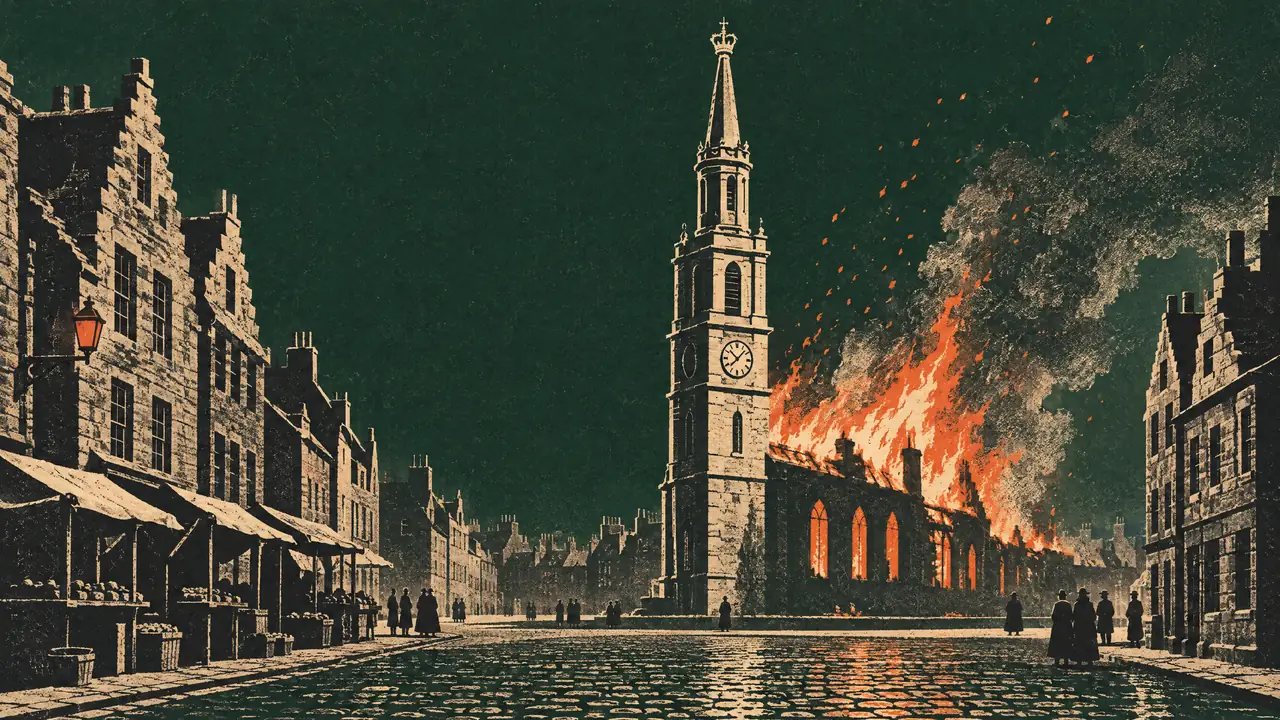
The Tron Steeple, with its arches over the pavement of the Trongate, is one of the oldest and best-loved landmarks in Glasgow. The church that once stood behind it met one of the strangest ends of any building in the city. In 1793, the story goes, members of a rowdy drinking society called the Hellfire Club broke into the church’s session house on a cold night, built up the fire to see who could stand the heat longest, and burned the kirk to the ground.
The Tron Kirk
A church stood on the south side of the Trongate long before the Reformation. In the middle of the sixteenth century James Houston, subdean of Glasgow and a former rector of the University, founded the Collegiate Church of St Mary and St Anne there, with a provost, canons and choristers who sang the daily services. Its Latin constitution of 1549 survives in the city archives.
At the Reformation of 1560 the college came to an end, and by 1570 the church was described as ruinous. It was restored as a city parish church in the 1590s and became known as the Tron Kirk, after the tron, the public weighing beam that gave the Trongate its name. Its tall steeple was completed in the 1630s and became one of the defining features of the old town around Glasgow Cross.
Clubs and drinking societies
Eighteenth-century Glasgow was a city of clubs. Merchants, professors and young men about town met in taverns to talk, gamble and drink, often to excess. Some clubs had gentle purposes; others were famous only for their drinking. One, the Morning Club, is said to have expected each member to drink three bottles at a sitting. The Face Club took its name from the sheep’s heads served at its dinners.
The Hellfire Club belonged to the wilder end of this world. Societies of that name, devoted to drink, blasphemy and defiance of respectable opinion, had appeared in London and Dublin earlier in the century, and Glasgow’s version was remembered as a band of hard-living young men looking for trouble.
The fire of 1793
According to the accounts handed down, members of the club broke into the session house of the Tron Kirk, where a fire was burning in the grate. They piled more and more fuel on to it, in a contest to see which of them could bear the heat longest. The fire got out of control. The flames spread to the church, and by the time they were put out the Tron Kirk was largely destroyed. The stone steeple survived.
Much about the night remains uncertain. The story has been retold so often that it has taken on the shape of legend. But the fire itself is well recorded, and the Hellfire Club has carried the blame for more than two centuries.
James Adam’s new church
The city acted quickly. A new church was built in 1793 and 1794 to a design by James Adam, brother of the more famous Robert Adam, who was also working on the new Royal Infirmary beside the cathedral. Adam’s church was a plain, classical box, set back slightly behind the old steeple rather than joined to it. The great preacher Thomas Chalmers later served as one of its ministers.
In the late nineteenth century an underground railway line was run through the gap between the church and the tower, and in 1900 a decorative wall was built to hide its ventilation shaft. Arches were cut through the base of the steeple so that the pavement could pass beneath it, giving the Trongate its familiar silhouette.
Police office and theatre
The Tron building has had many lives. Its long history includes service as a meeting hall and as a police station, a fitting chapter for a building once wrecked by lawbreakers. In 2000 a plaque marking the two hundredth anniversary of the Glasgow Police Act, which created one of the world’s first modern police forces, was unveiled on the building. That story is told in the history of the Glasgow police.
The congregation merged with St George’s in 1940, the church closed for worship in 1946 and the building was sold to the city in 1950. It decayed until 1980, when the Glasgow Theatre Club took it over for a rent of £1 a year. It has been the Tron Theatre ever since, one of the most admired theatres in Scotland. Today two modern sculptures by Kenny Hunter, a golden cherub and a skull, look down from its walls, a nod perhaps to the building’s darker past.
Timeline
| Date | Event |
|---|---|
| 1549 | Constitution of the Collegiate Church of St Mary and St Anne |
| 1560 | Reformation; the college ends |
| 1590s | Restored as a city parish church, the Tron Kirk |
| 1630s | Tron Steeple completed |
| 1793 | Church destroyed by fire blamed on the Hellfire Club; steeple survives |
| 1793 to 1794 | New church built to a design by James Adam |
| 1900 | Wall built to hide the underground railway ventilation shaft |
| 1946 | Church closes for worship |
| 1980 | Glasgow Theatre Club takes over the building |
| 2000 | Plaque for the bicentenary of the Glasgow Police Act unveiled |
Related questions
Did the Hellfire Club really burn down the Tron Kirk?
The fire of 1793 is well recorded, and tradition has always blamed members of the Hellfire Club, who are said to have built up the fire in the session house until it ran out of control.
What survived the fire?
The stone steeple, completed in the 1630s, which still stands on the Trongate today.
Who designed the new church?
James Adam, brother of Robert Adam. It was built in 1793 and 1794 behind the old steeple.
What is the Tron Kirk now?
The Tron Theatre, which has occupied the building since 1980.