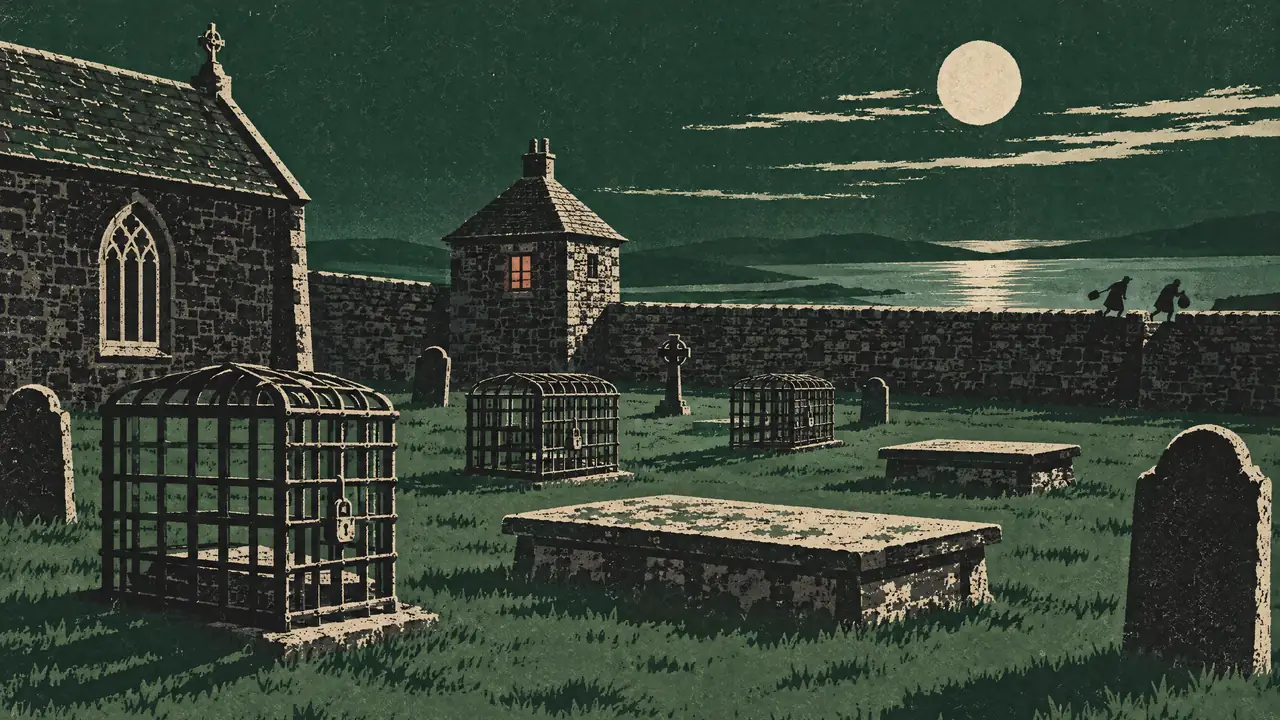
In the early nineteenth century Glasgow was becoming one of the great medical cities of Europe. Its university, its Royal Infirmary and a cluster of private anatomy schools were training hundreds of young doctors, and every one of them needed to learn the structure of the human body by dissecting it. The law supplied only a handful of corpses each year. The rest came from the city’s graveyards, lifted from fresh graves in the dark by students, lecturers and paid resurrection men. For a generation, grieving families in Glasgow feared that the people they had just buried would not stay buried.
Why the anatomists needed bodies
Anatomy was the foundation of the new scientific medicine, and Scotland led the field. Glasgow’s medical teaching expanded rapidly after 1800, at the University of Glasgow in the old College on the High Street and in independent schools such as those in College Street, where lecturers competed for fee-paying students. A teacher who could offer plenty of dissection attracted students; one who could not lost them.
The only legal supply was the bodies of executed murderers, which the Murder Act of 1752 handed to the surgeons as a further punishment. There were never enough of them. As medical schools grew and executions became less frequent, the gap between demand and supply widened, and the only way to fill it was to take the bodies of the recently dead from their graves. Because a dead body was not regarded as property, taking one was not theft in the ordinary sense, and the authorities often looked the other way.
Guarding the dead
To many Scots the violation of a grave was a horror beyond ordinary crime. Reverence for the dead ran deep, and many people believed that the body would rise again at the Last Judgement and should be whole when it did. Families went to great lengths to protect their own. The wealthy could afford heavy table stones, vaults and iron railings. Others placed flowers, shells or small stones on a grave in a careful pattern, so that any disturbance would be noticed. Heavy mortstones were laid over new graves, and soil was packed hard.
The most famous defence was the mortsafe, a heavy cage or frame of iron set over a coffin or a grave and padlocked in place for six weeks or so, until the body inside was of no use to the anatomists. Churches and societies bought them and hired them out. Surviving examples can still be seen near the city, for instance in the kirkyard of Cadder Parish Church at Bishopbriggs.
Families also kept watch. Friends and relatives sat up in kirkyards through the winter nights, sometimes in purpose-built watch-houses, and watching societies were formed in which members took turns to guard each other’s graves. One Glasgow society had some 2,000 members. Contemporary accounts say that at the height of the trade the Ramshorn and Cathedral burying grounds, close to the College and its dissecting rooms, were raided almost nightly.
The McAlister case, 1813
The case that brought public anger to boiling point began in December 1813. Janet McAlister, the wife of a Glasgow wool merchant and the mother of eight children, died at home on 8 December and was buried a week later in the new ground of the Ramshorn churchyard, the burying ground of St David’s Church on what is now Ingram Street. The next morning the gravedigger found the grave disturbed and the coffin empty apart from the grave clothes. A trail of mud and footprints led over the churchyard wall in the direction of College Street.
Word spread through the city. Crowds gathered, and a mob attacked the house of Dr James Jeffray, the professor of anatomy at the university, breaking its windows before the police restored order. Mrs McAlister’s brothers obtained a search warrant, and a party that included the dentist who had made her false teeth went to the anatomy rooms in College Street run by Granville Sharp Pattison, a young lecturer, and his colleague Andrew Russel.
The searchers found human remains in the rooms, some of them in a tub of water and others hidden beneath the floor. The dentist identified a jaw with teeth he said he had fitted to Mrs McAlister, and relatives identified a hand and other parts. Pattison, Russel and two students, Robert Munro and John McLean, were arrested and taken to jail through jeering crowds.
The trial of 1814
The four men were tried before the High Court of Justiciary in Edinburgh on 6 June 1814, charged with violating the grave and taking the body to their dissecting rooms. Five judges sat, a sign of how seriously the case was taken. The defence was conducted by two of the most brilliant advocates of the day, John Clerk and Henry Cockburn.
The prosecution evidence seemed strong, but the defence produced a remarkable answer. Medical witnesses testified that the female remains produced in court came from a woman who had never borne a child, whereas Mrs McAlister had borne eight. The false teeth, they argued, fitted other skulls equally well. The careless way in which the remains had been gathered and assembled after the search had confused the evidence beyond repair. The hearing ran until two in the morning. The jury returned verdicts of not guilty for Russel and McLean and not proven for Pattison and Munro, and all four were discharged with a warning from the bench.
The verdict satisfied almost nobody. It was obvious that Mrs McAlister’s body had been taken, and widely believed that it had ended up in College Street, even if the parts produced in court were not hers. Pattison’s position in Glasgow became impossible, and he soon left for America.
Burke, Hare and the Anatomy Act
The trade did not stop. Through the 1820s graveyards across Scotland were watched and raided, and in 1828 the crimes of William Burke and William Hare in Edinburgh showed where the market in bodies could lead: rather than robbing graves, they murdered at least sixteen people and sold the bodies to an anatomy lecturer. The public horror that followed finally forced Parliament to act.
The Anatomy Act of 1832 allowed licensed teachers of anatomy to receive bodies that were unclaimed after death, chiefly from hospitals, prisons and poorhouses, and placed the whole system under government inspectors. It ended the business of the resurrection men almost at once, and the mortsafes were gradually broken up or abandoned. It also created a new injustice of its own, since it was the bodies of the poorest people, who died without family able to pay for a funeral, that now went to the dissecting room. In amended form the Act still underpins anatomy in Scotland, where an Inspector of Anatomy continues to oversee the use of bodies donated for medical teaching.
Where to see the evidence today
Traces of the body snatching era can still be found in and around Glasgow. The Ramshorn burying ground survives behind the former St David’s Church on Ingram Street, a quiet green space in the Merchant City where Pierre Emile L’Angelier, the victim in the Madeleine Smith case, was buried in 1857. The old burial ground around Glasgow Cathedral was another regular target of the resurrection men.
Iron mortsafes survive in a number of Scottish kirkyards, including Cadder, north of the city, and the high walls and gatehouses of the Victorian cemeteries, built in the years when the fear of grave robbing was still fresh, are part of the same story. The University of Glasgow’s anatomy collections, built up over two centuries of teaching, are a reminder of why the anatomists wanted bodies so badly in the first place.
An ironic homecoming
Granville Sharp Pattison built a distinguished career in the United States, teaching anatomy at universities in Baltimore and New York. He died in New York in 1851. In March 1852 his body was brought back across the Atlantic and laid in the family enclosure in the Glasgow Necropolis, the grand cemetery on the hill beside the cathedral, which had opened in the 1830s offering the city’s wealthier families a secure and dignified place of burial. The man once accused of stealing a body from a Glasgow grave now lies, undisturbed, in one of its finest. More on the city’s burial grounds is on the historic cemeteries page.
Timeline
| Date | Event |
|---|---|
| 1752 | The Murder Act allows the bodies of executed murderers to be dissected |
| Early 1800s | Medical teaching expands rapidly in Glasgow; grave robbing increases |
| 8 Dec 1813 | Janet McAlister dies; she is buried in the Ramshorn churchyard a week later |
| December 1813 | Her grave is found empty; remains are found in College Street anatomy rooms |
| 6 to 7 June 1814 | Trial in Edinburgh; verdicts of not guilty and not proven |
| 1828 | Burke and Hare murders in Edinburgh |
| 1832 | The Anatomy Act gives anatomists legal access to unclaimed bodies |
| 1851 | Granville Sharp Pattison dies in New York |
| March 1852 | Pattison is buried in the Glasgow Necropolis |
Related questions
Why were bodies stolen from Glasgow graves?
Medical students and teachers needed bodies for anatomy classes, but before 1832 the law only allowed the bodies of executed murderers to be dissected. Graves were robbed to make up the shortfall.
What was a mortsafe?
A heavy iron cage or frame placed over a coffin or grave and locked in place for several weeks, until the body was no longer of use to the anatomists.
What happened in the 1813 Ramshorn case?
The body of Janet McAlister was stolen from the Ramshorn churchyard. Remains were found in Granville Sharp Pattison’s anatomy rooms, but at trial in 1814 the charges against Pattison were found not proven.
When did body snatching end in Scotland?
The Anatomy Act of 1832 gave anatomists legal access to unclaimed bodies, which ended the trade in stolen corpses almost immediately.