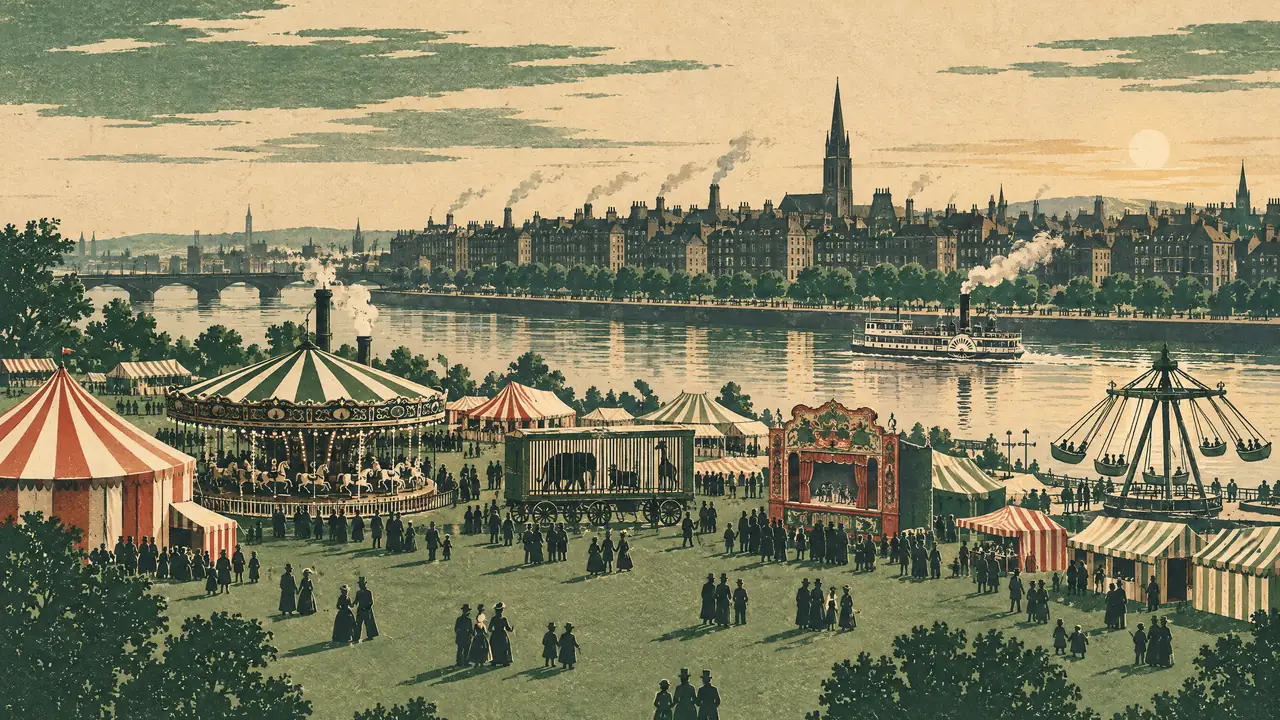
For more than eight hundred years the second half of July has belonged to the Glasgow Fair. It began in the 1190s as a royal licence to hold a market by the cathedral, and over the centuries it became a riot of travelling shows on Glasgow Green and then the most famous holiday in Scotland, when factories and shipyards closed, the city emptied and hundreds of thousands of Glaswegians went doon the watter to the Clyde coast. The Fair Fortnight is no longer what it was, but Glasgow Fair Monday is still a public holiday, and the Fair remains part of the city’s identity.
A royal grant
In the late twelfth century Glasgow was a small church town clustered around its cathedral. Its bishop, Jocelin, was ambitious for it. Around 1175 he obtained from King William the Lion the charter that made Glasgow a burgh, giving it the right to hold a weekly market, as described on our medieval burgh page. Around 1190 Jocelin secured a further grant from the king: the right to hold an annual fair.
A fair was a valuable privilege. For a set number of days each year merchants and traders could come to the town under the king’s protection, free from the usual tolls, to buy and sell. The Glasgow Fair was held in July, and in its early centuries it was above all a market for horses and cattle, along with goods of every kind and, in time, the hiring of servants and farm workers. It brought trade, visitors and income to the bishop’s town, and it helped to establish Glasgow as a market centre for the surrounding countryside.
From market to carnival
The fair was originally held in the area around the cathedral, the heart of the medieval town. Over the following centuries, as Glasgow grew down the hill towards the river, the fair followed it. By the eighteenth and nineteenth centuries the business of buying and selling livestock had given way to entertainment, and the fair had become a great popular carnival held near the foot of the Saltmarket and on Glasgow Green.
Travelling showmen from across Britain brought menageries, circuses, waxworks, freak shows, boxing booths and theatre companies. The penny geggies, or penny gaffs, offered short melodramas and comic turns for a penny. There was drinking, gambling and fighting too, which worried the city’s respectable classes. In 1871 the shows were moved to Vinegarhill, at the eastern edge of the Green, partly to keep the rowdier side of the fair away from the park.
The fair kept up with the times. In 1912 visitors could take a scenic railway ride that simulated a journey through Japan and back to Scotland, and during the First World War one of Glasgow’s carnivals offered a full-size reproduction of the trenches of the Western Front, guided by wounded soldiers.
The Fair Fortnight
By the nineteenth century the Fair had become something more than a carnival: it was the city’s great annual holiday. In industrial Glasgow most workers had very few days off, and the Fair period, in the second half of July, became the time when works, shipyards and factories closed. What had once been a few days grew into the Fair Fortnight.
The holiday began on Fair Friday, when workers were paid their holiday money. Families who had saved through the year packed their cases and headed out of the city on the Saturday. In 1855, on the first Saturday of the Fair, 41 steamers left the Broomielaw carrying an estimated 14,350 passengers down the river, while a further 26,000 people left the city by train. In the following century the numbers grew far larger.
Doon the watter
The favourite destinations lay along the Firth of Clyde and the Ayrshire coast. Rothesay, Dunoon, Largs, Saltcoats, Troon and Ayr filled with Glaswegians, and the paddle steamers that carried them down the river became part of the experience. Going doon the watter, as the city called it, meant boarding houses, crowded beaches, ice cream, dancing and the hope of a few warm days on the coast. Some families went further afield, to Blackpool, Whitley Bay or Portobello.
The Fair holiday found its way into Scottish culture. Neil Munro’s comic character Erchie MacPherson described the Glasgow Fair in a story published in 1904, and Billy Connolly’s song Saltcoats at the Fair celebrated the Ayrshire version of the holiday in 1969. Generations of Glaswegians have family photographs of the Fair: children on the sand at Rothesay, crowds on the piers, the steamer queue at the Broomielaw.
Decline and survival
From the 1960s the Fair Fortnight began to fade. As the shipyards and heavy industries that had shut down together each July declined, workers no longer took their holidays at the same time. Car ownership, staggered holidays and, from the 1970s, cheap package holidays to the Mediterranean drew families away from the Clyde resorts, and the great exodus of the Fair Saturday dwindled.
The Fair has not disappeared. Glasgow Fair Monday, the third Monday in July, is still a public holiday in the city, and many businesses close for a long weekend. The Merchant City Festival and other summer events now fill the traditional Fair period, and travelling funfairs still visit the city’s parks. A charter granted by a medieval king to an ambitious bishop is, in a sense, still being observed more than eight centuries later.
Timeline
| Date | Event |
|---|---|
| About 1175 | William the Lion grants Glasgow its burgh charter |
| About 1190 | Bishop Jocelin obtains the right to hold an annual fair |
| Medieval period | The fair is held near the cathedral as a market for livestock and goods |
| 1700s and 1800s | The fair becomes a carnival near the Saltmarket and Glasgow Green |
| 1855 | 41 steamers leave the Broomielaw on the first Fair Saturday |
| 1871 | The shows are moved to Vinegarhill |
| 1904 | Neil Munro writes about the Fair in an Erchie MacPherson story |
| 1960s onwards | The Fair Fortnight declines with heavy industry |
| Today | Glasgow Fair Monday remains a public holiday |
Related questions
How old is the Glasgow Fair?
The Glasgow Fair dates from around 1190, when Bishop Jocelin obtained the right to hold an annual fair from King William the Lion. It is one of the oldest fairs in Scotland.
When is the Glasgow Fair?
In the second half of July. Glasgow Fair Monday, the third Monday in July, is a public holiday in the city.
What does doon the watter mean?
It is Glasgow speech for going down the river: travelling down the Clyde by steamer or train to holiday resorts such as Rothesay, Dunoon, Largs and Ayr during the Fair.
Where was the Glasgow Fair held?
Originally near the cathedral. By the nineteenth century the shows were held near the foot of the Saltmarket and on Glasgow Green, and from 1871 at Vinegarhill.