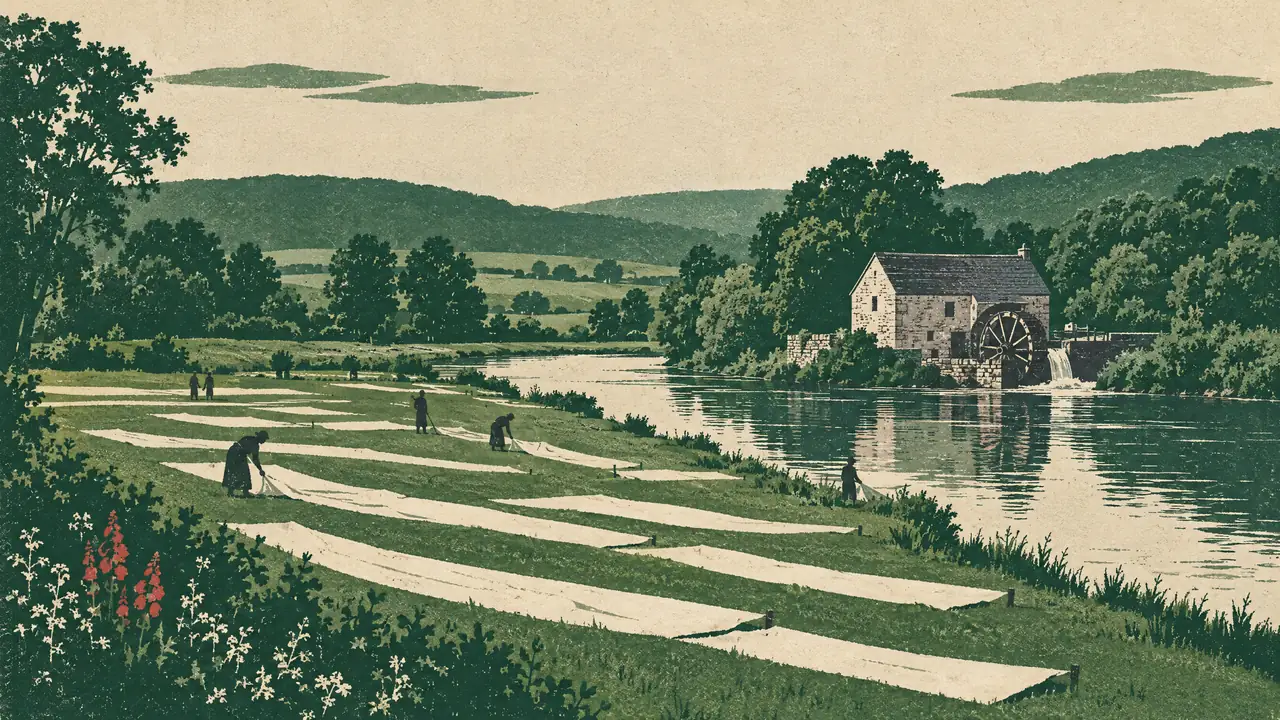
Between the tobacco ships and the cotton mills, Glasgow’s first great manufacture was linen. Spinning flax into yarn and weaving it into cloth was an old part of Scottish home life, carried on in cottages across the country. In the eighteenth century it became an industry. Encouraged by the state after the Union of 1707 and fed by demand from across the Atlantic, the west of Scotland turned linen into its leading manufacture, and Glasgow became one of its most important centres. It was linen that trained the region’s weavers, built its bleachfields and printworks and gave its merchants their first experience of manufacturing, all of which cotton would inherit.
A protected industry
After the Union, linen was the industry Scotland was encouraged to develop, partly because it did not compete with the English woollen trade. In 1727 the government set up the Board of Trustees for Fisheries, Manufactures and Improvements in Scotland, which paid grants to improve the growing and dressing of flax, set up spinning schools and supported new methods. In the 1730s the Trustees brought a Dutch flax-dresser to Scotland to teach the methods used in Holland, and Glasgow was invited to send a young man to learn from him. The town council paid its own subsidies for sowing lint, and around 1735 a society of linen dealers converted the town’s waulk mill on the Kelvin into a linen works.
Parliament helped too. An act of 1748 banned the import and wearing of French cambrics, protecting Scottish fine linen, and acts of 1751 paid a bounty on cheaper linen exported and allowed linen weavers to work anywhere in Scotland free of the dues charged by the burgh incorporations. In 1746 the British Linen Company was founded in Edinburgh, and it became the largest firm in the Scottish linen industry before turning to banking.
Fine cloth and smallwares
Glasgow made its name at the fine end of the trade. In 1736 a linen factory at Graham’s Hall, near the town, was weaving fine cloth in the Dutch manner said to be as good as that made at Haarlem, and sending it to Dalquhurn in the Vale of Leven for bleaching. By the 1760s the town was making lawns and cambrics "in the French manner", at first with imported French and Flemish yarn, and in 1767 skilled spinners were brought from France to the village of Anderston to make the finest yarns. By the early 1770s fine linen was described as the town’s main business, and Glasgow was producing more than two million yards of cloth a year.
Glasgow also became known for inkle, the narrow linen tape used for binding and trimming. The minister and diarist Alexander Carlyle recorded that the inkle manufacture was first begun by the merchants Ingram and Glassford, and by 1744 it was being shown to visitors as one of the town’s curiosities. When Bishop Pococke visited in 1760 he noted that Glasgow exported "all the inkle smallwares" and "linnens of all kinds".
Not all of the cloth was fine. Coarser linens, including the cheap, hard-wearing cloth known as osnaburg, were made for everyday use, and large quantities of coarse Scottish linen were shipped to the colonies, much of it to clothe enslaved people on the plantations. The same Atlantic trade that brought tobacco and sugar into the Clyde carried linen out, a link that runs through the history of the tobacco lords and the sugar trade.
Bleachfields and printfields
Linen needed finishing. Raw cloth was whitened by being spread out on open fields in the sunlight, and bleachfields spread along the rivers and burns around Glasgow and across Renfrewshire. Linen printing reached Scotland in 1738, and in 1742 Archibald Ingram, his brother-in-law John Glassford and other partners opened the first bleachfield and printworks at Pollokshaws, between the White Cart and the Auldhouse Burn. Ingram is remembered as the father of the printing trade, and the council named Ingram Street in the Merchant City after him in 1781. By the end of the century more than thirty printfields worked around the town.
The weavers
The cloth itself was woven by hand. Women spun flax into yarn, often part-time at home, and handloom weavers worked at their looms in their own houses, in the town and in the weaving villages growing up around it, among them the Calton, founded as a weavers’ village in 1705, and Anderston, laid out in the 1720s. Merchants and manufacturers supplied the yarn and collected and sold the finished webs. This dispersed army of skilled weavers, and the merchant networks that kept them working, would make the region’s next change remarkably fast.
Cotton moves in
Cotton first appeared in Glasgow around 1769, when master weavers in Anderston began using cotton weft in their cloth. Once machines could spin cotton cheaply, something flax could not match, the change came quickly. One of Scotland’s first cotton mills opened at Rothesay in 1779, water-powered mills followed across the west of Scotland, and the first steam-powered mill in Glasgow was built in 1792. The same weavers, merchants, bleachers and printers switched from flax to cotton within a generation. Cotton did not so much defeat linen as move into its house. The chemist Charles Tennant, who had run bleachfields at Darnley, patented his bleaching powder in 1799 and opened his chemical works at St Rollox in 1800, allowing cloth to be bleached indoors all year round and making the old bleaching greens redundant.
A forgotten foundation
Linen is the forgotten floor of Glasgow’s industrial house. For most of the eighteenth century it was the town’s leading manufacture: it trained the hands, built the bleachfields and printworks, and tied the merchant houses into the Atlantic trade. Then it handed everything to its successor so completely that it is easy to forget it was ever there. Its story is part of the wider history of Glasgow’s textile industry.
Timeline
| Date | Event |
|---|---|
| 1705 | Calton begun as a weavers’ village |
| 1727 | Board of Trustees for Fisheries, Manufactures and Improvements set up |
| 1736 | Fine linen woven at Graham’s Hall in the Dutch manner |
| 1738 | Linen printing reaches Scotland |
| 1742 | First bleachfield and printworks at Pollokshaws |
| 1746 | British Linen Company founded |
| 1748 | Import and wearing of French cambrics banned |
| 1767 | French spinners brought to Anderston |
| About 1769 | Cotton weft first used by Anderston weavers |
| Early 1770s | Glasgow producing over two million yards of linen a year |
| 1779 | One of Scotland’s first cotton mills opens at Rothesay |
| 1799 | Charles Tennant patents bleaching powder |
Related questions
Was linen important in Glasgow?
Yes. For most of the eighteenth century linen was Glasgow’s leading manufacture, and by the early 1770s the town was producing more than two million yards of cloth a year.
What kinds of linen did Glasgow make?
It was best known for fine lawns and cambrics and for inkle, a narrow linen tape, but coarser cloths were also made, much of it for export to the colonies.
Where was linen bleached and printed?
On bleachfields along the rivers around the town. The first bleachfield and printworks opened at Pollokshaws in 1742, and by 1800 there were more than thirty printfields around Glasgow.
Why did cotton replace linen?
Cotton could be spun cheaply by machine, which flax could not. From the 1780s Glasgow’s weavers, merchants and finishers switched to cotton within a generation.