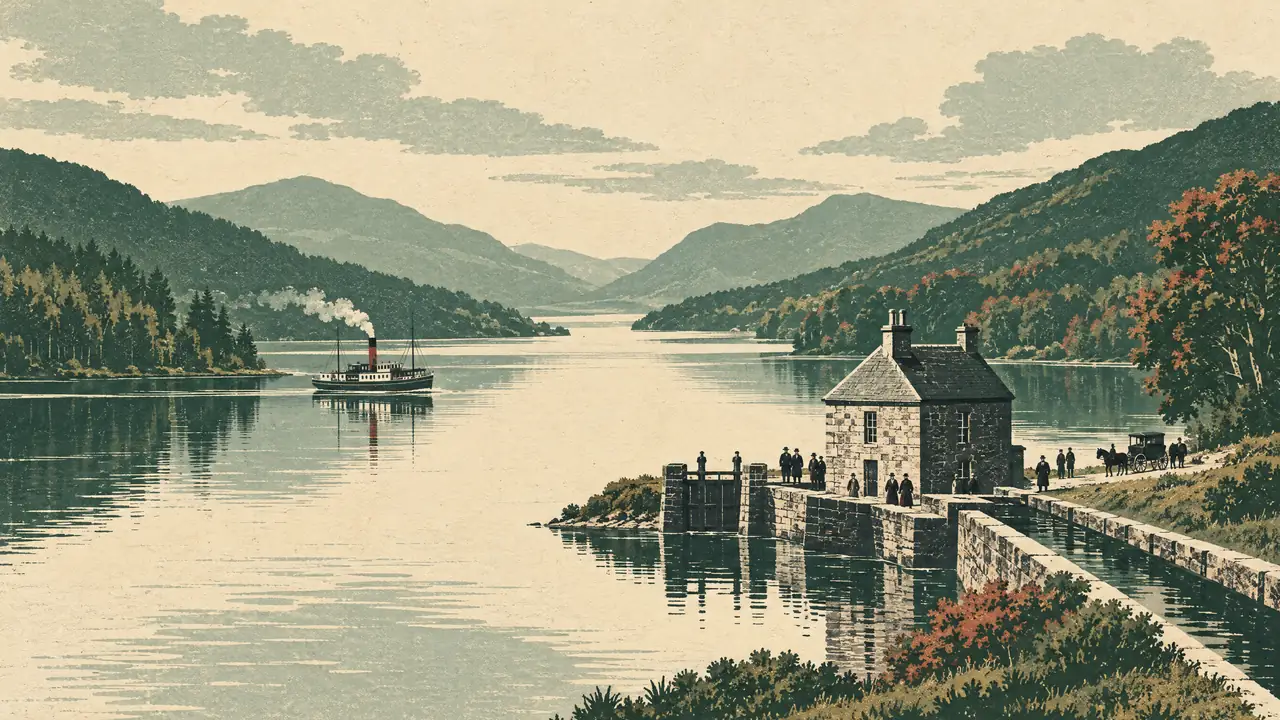
On 14 October 1859 Queen Victoria stood beside Loch Katrine, in the Trossachs, and opened a sluice that sent water from the Highland loch on its way to Glasgow. It was the start of one of the greatest engineering achievements of the Victorian age and one of the most important events in the history of public health in Scotland. Clean, soft water from Loch Katrine helped to bring an end to the cholera epidemics that had killed thousands of Glaswegians, and more than 165 years later it still flows from the taps of the city.
A city without clean water
In the early nineteenth century most Glaswegians got their water from public wells and from private water companies that pumped and filtered water from the River Clyde. As the population exploded, the supply became both inadequate and dangerous. The Clyde was increasingly polluted by sewage and industrial waste, and many people in the crowded closes of the old town had no piped water at all.
The consequences were deadly. Cholera struck Glasgow in 1832, 1848 to 1849 and 1853 to 1854, killing thousands of people each time, as described on our cholera epidemics page. Typhus and other diseases spread through the overcrowded tenements. Doctors and reformers increasingly argued that a plentiful supply of clean water was essential to the city’s health.
The decision
Several possible sources were considered. The town council, led by the Lord Provost, Robert Stewart, backed an ambitious plan to bring water from Loch Katrine, a deep and remarkably clean loch in the hills about thirty miles to the north, made famous by Sir Walter Scott’s poem The Lady of the Lake. The water was soft, pure and plentiful, and the loch lay high enough above the city for the water to flow all the way by gravity, without pumping.
The scheme met opposition from rival interests and from those who worried about its cost, but in 1855 Parliament passed an Act allowing Glasgow Corporation to build it and to take over the private water companies. It was a landmark decision that brought the city’s water supply into municipal ownership.
Building the aqueduct
The engineer was John Frederick Bateman, one of the leading water engineers of the age. His scheme raised the level of the loch and carried its water through an aqueduct of tunnels, cuttings, pipes and iron bridges across the hills and valleys of Stirlingshire to a great reservoir at Mugdock, near Milngavie, on the northern edge of the city. From there it was piped into Glasgow. Work began in 1855, and large numbers of labourers worked through the hills, blasting tunnels through hard rock, for four years.
The royal opening
The scheme was opened by Queen Victoria on 14 October 1859, accompanied by Prince Albert and two of their daughters. She turned the handle that opened the sluice, and the water began its journey to Glasgow. The supply was fully in operation by 1860.
The effect on the city’s health was dramatic. When cholera returned to Britain in 1866, Glasgow suffered far fewer deaths than in earlier epidemics, a result widely credited to the new water supply. Combined with the other reforms described on our public health reforms page, including improved drainage, slum clearance and the work of the city’s medical officers of health, clean water transformed life in the industrial city.
Expanding the supply
As Glasgow continued to grow, the scheme was enlarged. An Act of 1885 allowed further works, and a second aqueduct was completed in 1901. A dam and tunnel bringing water from neighbouring Loch Arklet was completed in 1914, and a tunnel from the Glen Finglas reservoir in the 1950s, with its dam completed in 1965. The treatment works at Milngavie, high above the city, still allow the water to reach most of Glasgow without pumping, and the system can supply up to around 230 million litres a day.
Because Loch Katrine supplies drinking water, it has been carefully protected. Oil-fired boats are banned from the loch, and the steamship Sir Walter Scott, which has carried visitors on the loch since 1900, was converted from coal to biofuel in 2007. Today the loch is owned by Scottish Water and is a popular destination for visitors from Glasgow.
The Stewart Memorial Fountain
Glasgow celebrated its new water supply with one of its most elaborate monuments. The Stewart Memorial Fountain in Kelvingrove Park, built in 1871 to 1872, commemorates Lord Provost Robert Stewart and the Loch Katrine scheme. Richly carved in granite, sandstone and marble, with bronze details, it is crowned by a figure of the Lady of the Lake and decorated with imagery of the loch and the Trossachs. After a long period out of use, it was restored and switched on again on 14 October 2009, exactly 150 years after the royal opening.
Timeline
| Date | Event |
|---|---|
| 1832 | First cholera epidemic in Glasgow |
| 1848 to 1849 | Second cholera epidemic |
| 1853 to 1854 | Third cholera epidemic |
| 1855 | The Glasgow Corporation Water Works Act is passed; work begins |
| 14 Oct 1859 | Queen Victoria opens the scheme at Loch Katrine |
| 1860 | The supply is fully in operation |
| 1866 | Cholera returns but Glasgow suffers far fewer deaths |
| 1871 to 1872 | The Stewart Memorial Fountain is built in Kelvingrove Park |
| 1901 | A second aqueduct is completed |
| 1914 | Water from Loch Arklet is added |
| 1965 | The Glen Finglas dam is completed |
| 14 Oct 2009 | The restored Stewart Memorial Fountain is switched on |
Related questions
When did Glasgow get water from Loch Katrine?
Queen Victoria opened the Loch Katrine water scheme on 14 October 1859, and the supply was fully in operation by 1860.
Who designed the Loch Katrine water scheme?
The engineer John Frederick Bateman. The scheme was championed by Lord Provost Robert Stewart.
Does Glasgow’s water still come from Loch Katrine?
Yes. Loch Katrine, owned by Scottish Water, is still the main source of water for much of Glasgow, carried by aqueduct to treatment works at Milngavie.
What is the Stewart Memorial Fountain?
A fountain in Kelvingrove Park built in 1871 to 1872 to commemorate Lord Provost Robert Stewart and the Loch Katrine water scheme.