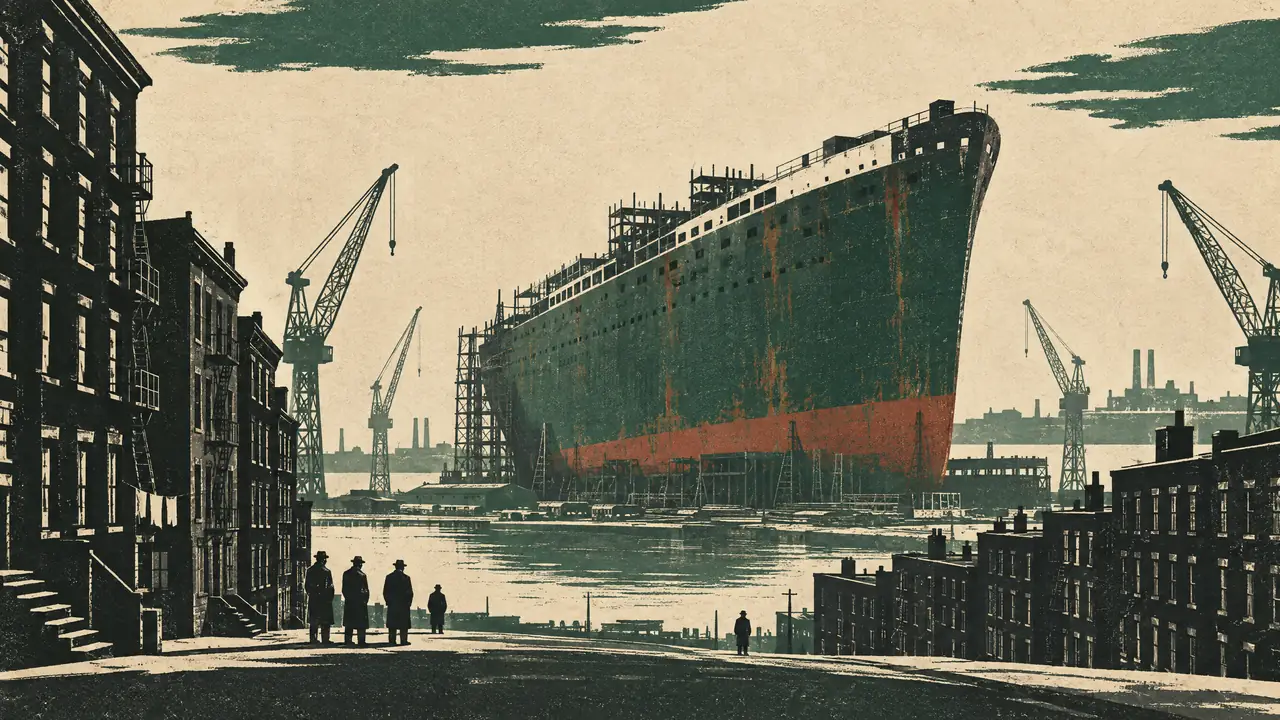
She was known at first simply as No. 534. Ordered by Cunard as the largest and fastest liner the company had ever attempted, she became a symbol first of Clydebank’s suffering in the Depression, then of its recovery, and finally of the skill of the men who built her. The Queen Mary sailed the Atlantic for three decades, served through the Second World War, and is still afloat at Long Beach, California, more than ninety years after her launch.
Job No. 534
The contract was signed at John Brown’s yard in Clydebank on 1 December 1930, and the first keel plates were laid later that month. Cunard needed a new express liner to compete with the great German and French ships then appearing on the North Atlantic, and the scale of the project was without precedent on the Clyde.
The silent yard
Within a year the Depression had caught up with Cunard. On 11 December 1931 work on No. 534 stopped, and around 3,000 men at the yard lost their jobs, with thousands more affected at suppliers across Britain. For more than two years the unfinished hull stood on the slipway above Clydebank, a giant and very visible reminder of a town and an industry brought to a halt.
Rescue came from the government. In 1934 Cunard was offered a loan of around £9.5 million to finish the ship and build a running mate, on condition that it merge with its old rival, the White Star Line. Work resumed in April 1934, and the men marched back into the yard behind pipers. Their first task was to clear away birds’ nests and more than 130 tons of rust. The merged company, Cunard White Star, was formed in May.
The launch
On 26 September 1934, in front of a vast crowd and with King George V beside her, Queen Mary named the ship after herself and sent her down the ways into the Clyde. Drag chains slowed the huge hull so that it would not run into the far bank. A popular story claims that Cunard had intended to call the ship Victoria, and that the name was changed after a misunderstanding with the King. Cunard always denied this, and the story remains a legend rather than established fact.
Fitting out took another eighteen months. She was about 1,019 feet long and measured more than 80,000 gross tons, and she left the Clyde in 1936 for trials and service from Southampton.
Queen of the Atlantic
The Queen Mary sailed on her maiden voyage on 27 May 1936. In August that year she took the Blue Riband for the fastest Atlantic crossing from the French liner Normandie, at an average of more than 30 knots. The Normandie took it back the following year, but in 1938 the Queen Mary regained the record, and she held it until 1952. Her art deco interiors made her one of the most glamorous ships afloat, and she carried film stars, politicians and royalty between Europe and America.
The Grey Ghost
In the Second World War she was painted navy grey and became a troopship. Her speed meant she could outrun submarines, and her grey paint and her speed earned her the nickname the Grey Ghost. On one crossing in July 1943 she carried 16,683 people, 15,740 of them soldiers, still the record for the most people aboard a single vessel. Together with her younger sister, the Queen Elizabeth, also built at Clydebank, she moved huge numbers of troops, and Winston Churchill later said that without the help of the two Queens the final victory would have been postponed.
The war also brought her darkest day. On 2 October 1942, off the coast of Ireland, she struck and cut through her escorting cruiser, HMS Curacoa, and more than three hundred sailors were killed. Under orders not to stop because of the danger from submarines, the liner continued on her way.
Long Beach
After the war she returned to passenger service, but air travel steadily took her trade. Her last Atlantic crossing was in September 1967, and on 31 October she left Southampton for the last time, sailing round Cape Horn to Long Beach, where she arrived on 9 December 1967. She opened to the public in 1971 and has served as a hotel, museum and attraction ever since, though her condition has caused concern and she has needed major repairs.
She stands with the Lusitania and HMS Hood among the most famous Clyde-built ships, and she is one of the most remarkable survivors of the great age of Clyde shipbuilding.
Timeline
| Date | Event |
|---|---|
| 1 December 1930 | Contract for No. 534 signed at John Brown’s |
| 11 December 1931 | Work stops in the Depression |
| April 1934 | Work resumes after a government loan |
| 26 September 1934 | Launched by Queen Mary at Clydebank |
| 27 May 1936 | Maiden voyage from Southampton |
| August 1936 | Wins the Blue Riband |
| 1938 | Regains the Blue Riband, holding it until 1952 |
| 2 October 1942 | Collision with HMS Curacoa |
| July 1943 | Carries 16,683 people on one crossing |
| 31 October 1967 | Leaves Southampton for the last time |
| 9 December 1967 | Arrives at Long Beach, California |
Related questions
Where was the Queen Mary built?
At John Brown and Company’s yard in Clydebank on the Clyde, where she was known during construction as No. 534.
Why did work on the Queen Mary stop?
The Depression. Work stopped in December 1931 and resumed in April 1934, after a government loan conditional on Cunard merging with the White Star Line.
Who launched the Queen Mary?
Queen Mary herself, with King George V present, on 26 September 1934.
Where is the Queen Mary now?
She has been at Long Beach, California, since December 1967, and has served as a hotel, museum and attraction since 1971.