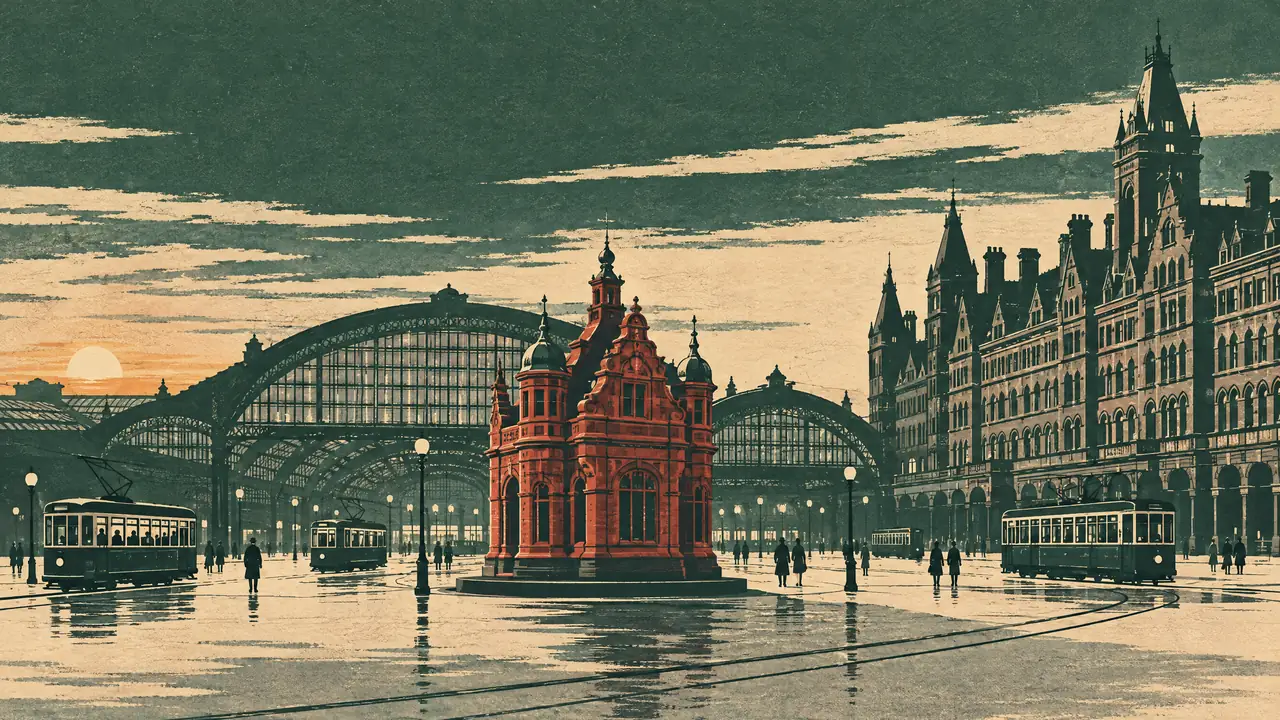
The name is the square’s oldest story. St Enoch is a worn-down form of Thenew, the mother of St Mungo, whose legend stands at the very beginning of Glasgow’s history. A medieval chapel dedicated to her stood near this spot, outside the old town, and when the eighteenth-century burgh expanded west and laid out a square here, the name came with it. Since then St Enoch Square has been a quiet Georgian square, a business address, the forecourt of one of the great railway stations of Victorian Britain and the doorstep of a vast glass shopping centre. Through all of it, one small red sandstone building has survived in the middle.
St Thenew’s chapel and well
By tradition, Thenew was a princess of the Lothians who was cast adrift in a boat and came ashore at Culross in Fife, where she gave birth to Kentigern, the saint Glasgow knows as Mungo. In the Middle Ages a chapel dedicated to her stood in this area, and her bones were said to be preserved within its walls. Nearby was a holy well, mentioned in the burgh records in 1573 and 1595. A tree grew beside it into which people pressed pieces of metal as offerings, and some of these were recovered when the well was cleaned out at the end of the eighteenth century. The chapel did not survive the Reformation, but the saint’s name, altered over the centuries to St Enoch, stayed attached to the ground.
The Georgian square
In the 1760s the town council bought the land, then a cornfield on the western edge of the town, and laid out a square. Its centrepiece was St Enoch’s Church, begun in 1780 to a design by James Jaffray, and for a few years it stood alone before terraced houses rose on the east and west sides. The square was soon one of the most fashionable addresses in Glasgow, though not for long. Within forty years the houses had become merchants’ offices, warehouses, banks and counting houses, and one writer called the square "the very heart of stirring and living commerce". The church was rebuilt in 1827 to designs by David Hamilton, the leading Glasgow architect of the day.
The railway arrives
The railway changed the square for ever. In the 1870s buildings on the east side were cleared for the lines of the City of Glasgow Union Railway, which crossed the Clyde to reach a new terminus. St Enoch Station received its first passenger train on 1 May 1876 and was officially opened on 17 October that year. It was designed by the engineers John Fowler and James F. Blair, and its great arched train shed of iron and glass spanned more than 200 feet. In 1883 the Glasgow and South Western Railway took over the station and made it its headquarters, and from here trains ran to Ayrshire, the south-west of Scotland and, by way of Carlisle, to England. The station was enlarged between 1898 and 1902 with a second shed, giving it twelve platforms.
In front of the station rose the St Enoch Hotel, designed by Thomas Willson with Miles S. Gibson and opened on 3 July 1879. With more than two hundred bedrooms it was the largest hotel in Glasgow, and was described as the largest in the country. It was among the first buildings in the city to be lit by electricity, and for decades it was where well-to-do travellers to Glasgow stayed.
The subway building
In 1896 the Glasgow Subway opened with a station beneath the square. Its entrance building, designed by James Miller, is a miniature palace of red sandstone in a Flemish Renaissance style, with four corner turrets, and it housed the booking office and the headquarters of the Glasgow District Subway Company. When the subway was modernised in the late 1970s the building was kept because of its listed status, and it later served as a travel information centre. It is listed at Category A, and since 2009 it has been a coffee shop, one of the most charming small buildings in the city centre.
Losses
The twentieth century took almost everything else. St Enoch’s Church was demolished in 1926 to make room for a bus terminus and car parking. The station closed on 27 June 1966, when its services were transferred to Central Station in the railway cuts of the decade, and the hotel closed in 1974. In 1977 both were demolished, despite protests, and much of the rubble went to fill in Queen’s Dock, where the Scottish Event Campus now stands. The station and hotel are counted among the great lost buildings of Glasgow.
The glass house
On the site rose the St Enoch Centre, which opened in May 1989 and was officially opened by Margaret Thatcher the following year. Its great glass roof, said to cover the largest glass-enclosed area in Europe, earned it the nickname "the Glasgow Greenhouse". The centre has been altered several times since, and in 2023 the council gave planning permission in principle for a long-term redevelopment that would replace it with new streets of shops, homes, offices and a hotel.
The square today
St Enoch Square sits between the polish of Buchanan Street and the slower revival of the riverside, and is busiest in winter, when it hosts Glasgow’s Christmas market. It has been holy ground, Georgian square, railway forecourt and retail plaza in turn, and keeps, in its name, the memory of the woman from whom Glasgow’s founding legend descends.
Timeline
| Date | Event |
|---|---|
| 1573 and 1595 | St Thenew’s well recorded in the burgh records |
| 1760s | Town council buys the land and lays out a square |
| 1780 | St Enoch’s Church begun, designed by James Jaffray |
| 1827 | Church rebuilt to designs by David Hamilton |
| 17 October 1876 | St Enoch Station officially opened |
| 3 July 1879 | St Enoch Hotel opens |
| 1883 | Glasgow and South Western Railway takes over the station |
| 14 December 1896 | Subway opens, with James Miller’s station building |
| 1926 | St Enoch’s Church demolished |
| 27 June 1966 | St Enoch Station closes |
| 1977 | Station and hotel demolished |
| May 1989 | St Enoch Centre opens |
Related questions
Who was St Enoch?
St Enoch is a corrupted form of Thenew, the mother of St Mungo in Glasgow’s founding legend. A medieval chapel and holy well dedicated to her stood near the square.
When did St Enoch Station close?
It closed on 27 June 1966, and its trains were transferred to Central Station. The station and the St Enoch Hotel were demolished in 1977.
What is the little building in the middle of the square?
It is the original St Enoch subway station building of 1896, designed by James Miller. It housed the subway company’s booking office and headquarters and is now a coffee shop.
Why is the St Enoch Centre called the greenhouse?
Because of its huge glass roof, said when it opened in 1989 to cover the largest glass-enclosed area in Europe.