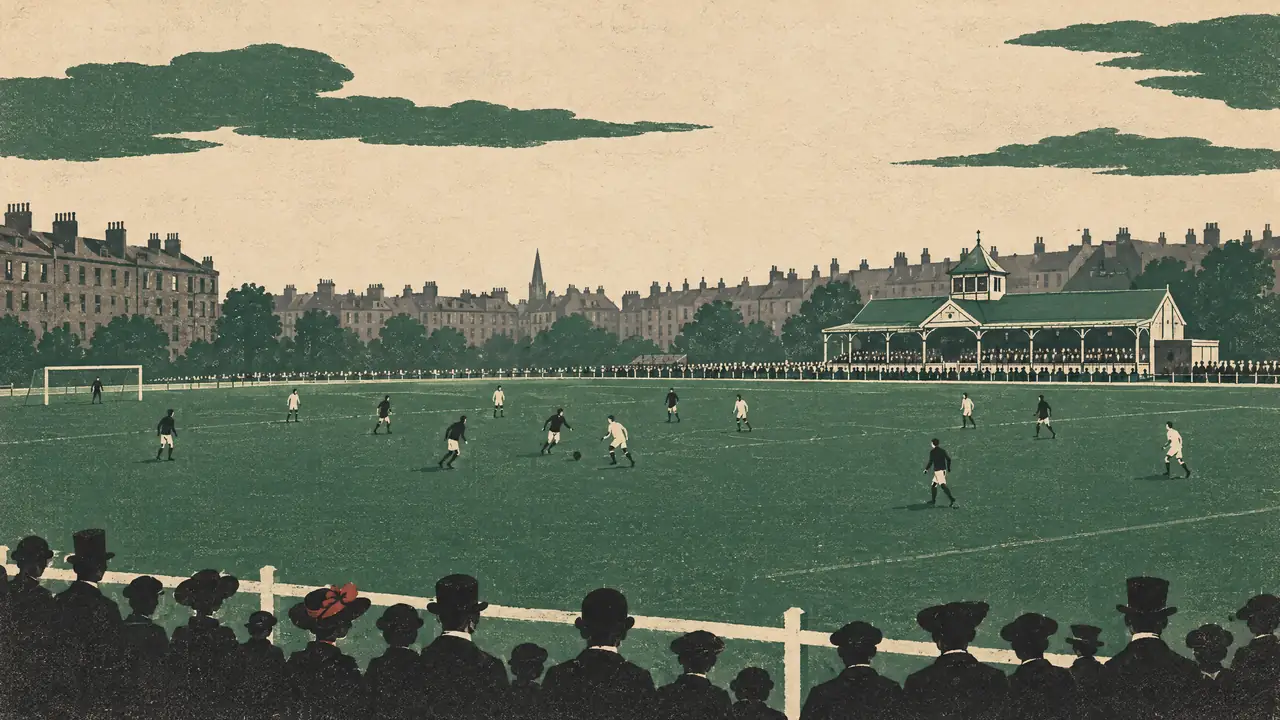
Organised football in Glasgow began on 9 July 1867, when a group of young men met at No. 3 Eglinton Terrace on the south side and founded Queen’s Park, the oldest association football club in Scotland. Within a few years the club had provided the whole of Scotland’s team for the world’s first official international match, helped found the Scottish Football Association and built the first Hampden Park. Glasgow had become the centre of the Scottish game, and it has remained so ever since.
Queen’s Park
Some of the founders had links with the local YMCA, and the name was chosen by a single vote over alternatives including The Celts and The Northern. The club played on the recreation ground in Queen’s Park, Crosshill, and opponents were so scarce that its first recorded match came more than a year later, a 2–0 win over a club called Thistle on 1 August 1868. Queen’s Park were fiercely amateur. They declined to join the Scottish Football League when it began in 1890, joining only in 1900, and remained amateur until 2019. Their motto, Ludere Causa Ludendi, means to play for the sake of playing.
The first international
In 1872 Charles Alcock, secretary of the Football Association in London, challenged Scotland to a match. With no Scottish association yet in existence, Queen’s Park took up the challenge. On 30 November 1872, St Andrew’s Day, Scotland met England at the West of Scotland Cricket Ground at Hamilton Crescent in Partick. All eleven Scotland players came from Queen’s Park, and they wore the club’s blue. Admission was a shilling, and the crowd is put at between about 2,500 and 4,000, depending on the source. The match finished 0–0, and FIFA recognises it as the first official international between national teams.
The passing game
Football in the early 1870s was dominated by dribbling, with players running with the ball while teammates followed in support. England fielded eight forwards at Hamilton Crescent, while Scotland played with two backs, two half-backs and six forwards. Queen’s Park are widely credited with developing combination football, in which players pass the ball to teammates moving into space, and one London paper reported that the Scots seemed to be adepts at passing. Historians debate how far the style was fully formed in 1872, and some passing was already being played elsewhere. But the Scottish game became known for combination play, and it spread from Glasgow far beyond Scotland.
Building a national game
In March 1873 Queen’s Park and seven other clubs founded the Scottish Football Association in Glasgow, and the Scottish Cup began that same season. Queen’s Park moved to their first enclosed ground, named Hampden Park after nearby Hampden Terrace, where the first match was played on 25 October 1873. In March 1874 they beat Clydesdale 2–0 at Hampden to win the first Scottish Cup final, and in 1878 the same ground staged Scotland against England. They went on to win the trophy ten times, and in 1884 and 1885 they reached the English FA Cup final, losing both times to Blackburn Rovers.
A city of clubs
New clubs appeared across the city. Rangers were founded in 1872 by a group of teenagers who played on Glasgow Green, Partick Thistle followed in 1876 and Clyde in 1877. In November 1887 Celtic were founded in the East End by Brother Walfrid, a Marist brother, to raise money for the poor. In time the rivalry between Celtic and Rangers had begun to draw the biggest crowds in the game.
The Scotch professors
As football in the north of England grew, clubs there began to recruit skilled Scottish players, whispered to be paid at a time when payment was forbidden. They became known as the Scotch professors. Among the first were Jimmy Love and Fergus Suter, who left the Partick club for Darwen in Lancashire in 1878. Suter, a stonemason, had lost work after the collapse of the City of Glasgow Bank that year, and he later won the FA Cup with Blackburn Rovers. The flow of Scottish players south helped push England to legalise professionalism in 1885, and they carried the passing game with them.
A football city
By the end of the century Glasgow had become the greatest football city in Britain. Queen’s Park opened the present Hampden Park in 1903, a vast new ground that would draw a British record crowd of 149,415 for Scotland against England in 1937. Ibrox and Celtic Park drew huge crowds too. The story of what followed is told in Glasgow’s football history, but it all began with a few young men on the south side in 1867.
Timeline
| Date | Event |
|---|---|
| 9 July 1867 | Queen’s Park founded at Eglinton Terrace |
| 1 August 1868 | Queen’s Park’s first recorded match, against Thistle |
| 1872 | Rangers founded |
| 30 November 1872 | Scotland 0 England 0 at Hamilton Crescent |
| March 1873 | Scottish Football Association founded |
| 25 October 1873 | First match at the first Hampden Park |
| March 1874 | Queen’s Park win the first Scottish Cup final |
| 1876 | Partick Thistle founded |
| 1878 | Love and Suter leave Partick for Darwen |
| 1884 and 1885 | Queen’s Park reach the FA Cup final |
| November 1887 | Celtic founded |
| 1903 | The present Hampden Park opens |
Related questions
What was the first football club in Glasgow?
Queen’s Park, founded on 9 July 1867 on the south side of the city. It is the oldest association football club in Scotland.
Where was the first international football match played?
At the West of Scotland Cricket Ground, Hamilton Crescent, Partick, on 30 November 1872. Scotland and England drew 0–0.
Did Glasgow invent the passing game?
Queen’s Park are widely credited with developing combination passing, though historians debate how fully formed it was in 1872. It became the hallmark of Scottish football.
Who were the Scotch professors?
Scottish players recruited by English clubs from the late 1870s, among the first of them Jimmy Love and Fergus Suter from Partick. They helped bring professionalism to England in 1885.