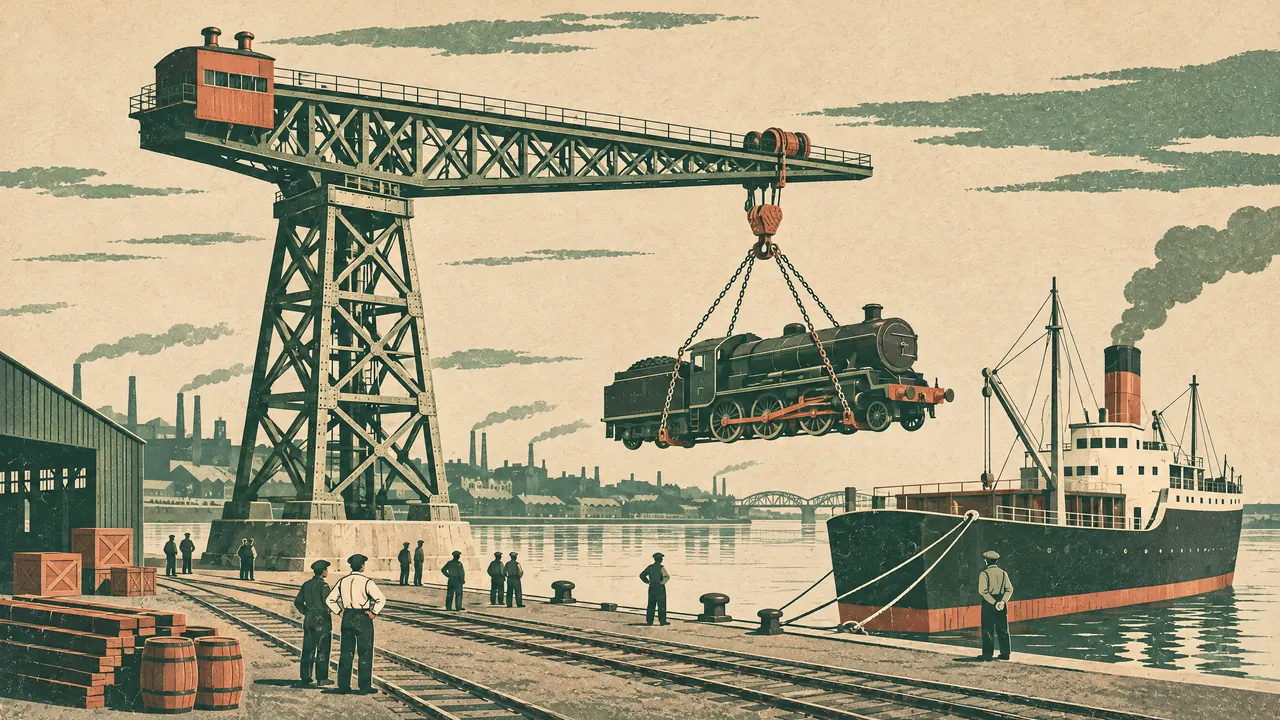
The Finnieston Crane was used to lift heavy cargo, above all steam locomotives, onto ships for export around the world. Built for the Clyde Navigation Trust and in use from 1932, it could lift 175 tons. Locomotives built in the Springburn works in the north of the city were hauled through the streets to the quayside, where the crane swung them aboard ships bound for India, Africa, South America and beyond. It is no longer in working order, but it is Category A listed and kept as a symbol of Glasgow’s engineering heritage.
Why was it built?
In the late nineteenth and early twentieth centuries Glasgow was one of the world’s great centres of heavy engineering. The North British Locomotive Company, formed in 1903 in Springburn, was the largest locomotive builder in Europe, and Glasgow-built engines ran on railways across the British Empire. Getting those huge machines onto ships required a crane of enormous strength, close to deep water and connected to the railway.
There had been big cranes at Finnieston before. The first to be called the Finnieston Crane was moved to Finnieston Quay in 1848 and tested with a load of 30 tons of pig iron, for lifting machinery onto steamships. A powerful 130-ton steam crane was later built nearby in the 1890s, but it was removed to make way for a planned bridge across the river that was never built. The Clyde Navigation Trust ordered a replacement in 1928.
How was the Finnieston Crane built?
The present crane was completed in 1931 and began work in 1932. Its tower was built by Cowans, Sheldon and Company of Carlisle and its huge cantilever arm by the Cleveland Bridge and Engineering Company, under the supervision of Daniel Fife, the Clyde Navigation Trust’s mechanical engineer. Sir William Arrol and Company, builders of many other Clyde cranes, helped with the design of the foundations. Including those foundations, it cost £69,000.
It was the last giant cantilever crane built on the Clyde. Its key figures are impressive even today:
- 53 metres (175 feet) tall
- a cantilever jib 46 metres (152 feet) long
- a lifting capacity of 175 tons
- a full rotation in about three and a half minutes
Workers reached the top by a steel staircase or by an electric lift, the only personnel lift of its kind on a British crane. A smaller auxiliary hoist, known as the jigger, ran along a rail on the jib to handle lighter loads.
Why is it called the Finnieston Crane?
Strictly speaking, it is the Stobcross Crane, or Clyde Navigation Trust crane number 7, because it stands on Stobcross Quay. It became known as the Finnieston Crane because of its position near Finnieston Quay and because it replaced the earlier crane of that name. The nickname stuck, and today almost nobody calls it anything else.
Locomotives through the streets
The crane sat on a branch of the Stobcross Railway, but many locomotives made the journey from Springburn by road. Over the decades, as many as 30,000 locomotives are said to have been pulled through the streets of Glasgow, first by teams of Clydesdale horses and later by traction engines and tractors, on their way to the quayside. The sight of a giant engine rumbling through the city on its way to the crane was a familiar one for generations of Glaswegians.
As well as locomotives, the crane lifted other heavy machinery, including boilers and tanks.
When did it stop working?
As the British locomotive industry declined after the Second World War and cargo moved to container ships, the crane had less and less to do. The docks it served, including the Queen’s Dock, closed in 1969 and were later filled in. The site is now home to the Scottish Event Campus and the Clyde Auditorium, known as the Armadillo. By the late 1980s the crane was no longer in working order.
Rather than demolish it, the city kept the crane as a monument. It is one of only four giant cantilever cranes left on the Clyde, and one of just a handful left anywhere in the world. It is not normally open to the public, but it has become a canvas for art. In 1987 the sculptor George Wyllie hung a full-size straw locomotive from it, and after his death in 2012 a giant question mark was suspended in his memory. During the 2026 Commonwealth Games a sculpture called the Glasgow Rose hung from its jib.
Related questions
Is the Finnieston Crane still used?
No. The crane is no longer in working order. It is kept as a Category A listed monument to Glasgow’s shipbuilding and engineering past.
Can you go up the Finnieston Crane?
The crane is not normally open to the public. You can see it best from the riverside walkways, the Clyde Arc or across the river at Pacific Quay.
How much could the Finnieston Crane lift?
It could lift 175 tons, enough to load the heaviest steam locomotives built in Glasgow onto waiting ships.
Why is it called the Finnieston Crane and not the Stobcross Crane?
Although it stands on Stobcross Quay, it was named after nearby Finnieston Quay and the earlier Finnieston Crane it replaced.