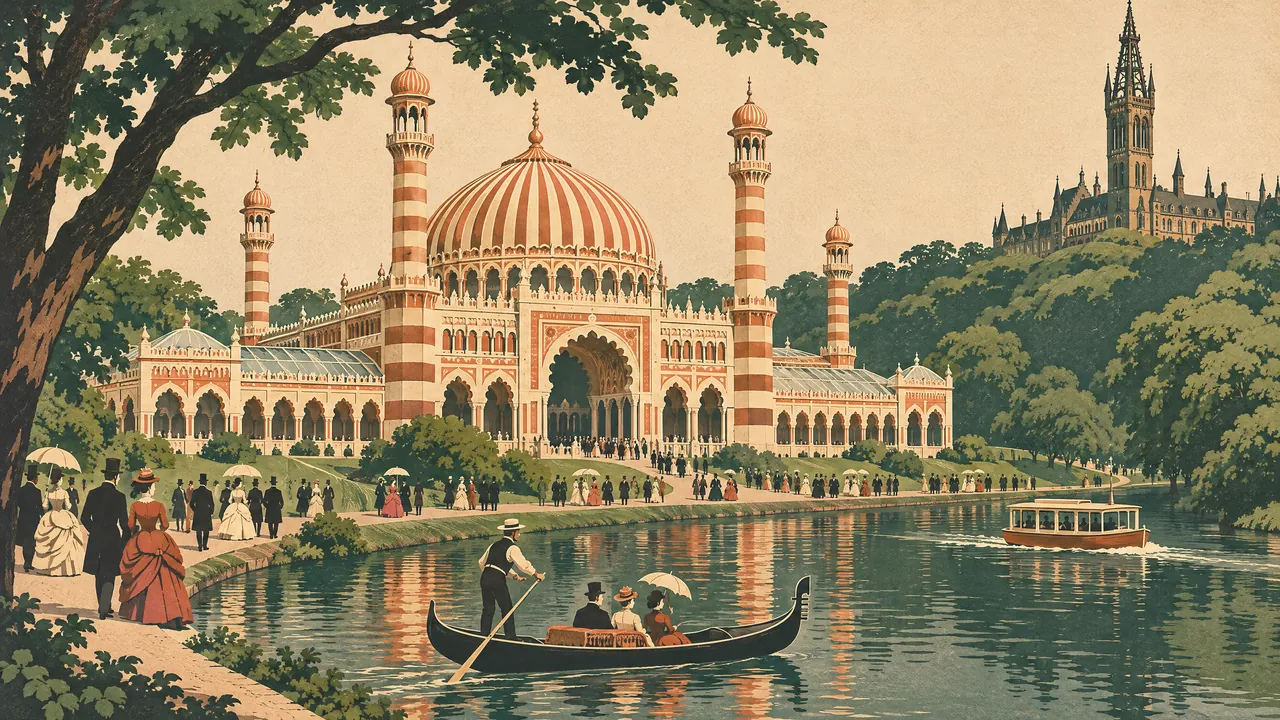
The 1888 International Exhibition of Science, Art and Industry was a six-month world’s fair held in Kelvingrove Park in Glasgow’s West End, from 8 May to November 1888. It showcased the city’s industry, science and art, drew 5,748,379 visitors and made a profit of £43,000, which helped pay for Kelvingrove Art Gallery and Museum. It was the first of four great international exhibitions held in Glasgow, and the largest exhibition held anywhere in Scotland in the nineteenth century.
Why did Glasgow hold an exhibition in 1888?
By the 1880s Glasgow was proud to call itself the Second City of the Empire. Its shipyards, locomotive works, chemical plants and textile mills were famous across the world, and its leaders wanted to show off that success on a grand scale, in the tradition of London’s Great Exhibition of 1851 and the more recent exhibition held in Edinburgh in 1886. The exhibition aimed to draw international attention to the city’s achievements in applied science, industry and the arts.
There was a practical purpose too. Glasgow had valuable art collections but nowhere fitting to show them, and the organisers hoped the exhibition would raise enough money for a new museum and art gallery, and a school of art, for the city.
Baghdad by the Kelvin
The buildings were designed by the Glasgow architect James Sellars, who won a competition for the job. He chose an exotic Oriental style, partly because it looked spectacular and partly because, as he explained, it lent itself to construction in wood. Everything was meant to be temporary and easy to take down afterwards.
The Main Building stretched through Kelvingrove Park between the River Kelvin and Sandyford Street, roughly where Sauchiehall Street now runs. At its centre was a dome 170 feet high, built on an iron frame covered in galvanised sheet iron, with four brick towers topped by minarets. With its domes and turrets glowing in the summer sun, the exhibition was soon nicknamed Baghdad by the Kelvin.
What was on show?
Around two thirds of the exhibitors were Scottish, many of them Glasgow firms showing engines, ships’ models, machinery, textiles and chemicals. Most of the rest came from England, especially London, Lancashire and Yorkshire, while India and Canada sent the largest displays from overseas. About seventy firms came from outside the British Empire, mostly from France, Germany, Italy and the United States.
One of the most impressive exhibits was the Doulton Fountain, a towering terracotta monument made by Doulton and Company of London. After the exhibition the company gave it to the city, and in 1890 it was moved to Glasgow Green. Standing 46 feet high with a basin 70 feet across, it is the largest terracotta fountain in the world and today stands, restored, in front of the People’s Palace.
Art played a big part too. The painter John Lavery, then one of the young Glasgow Boys, captured the exhibition in a series of lively sketches and was commissioned to paint Queen Victoria’s visit in August 1888, the same visit during which she opened the new City Chambers in George Square.
Fun on the Kelvin
To widen its appeal, the exhibition had a separate entertainment area between the University of Glasgow and the west bank of the Kelvin. Visitors could ride a switchback railway, an early kind of roller coaster, try a shooting gallery, go up in a captive balloon and listen to brass bands. Football matches, cycle races and Highland games took place at the university’s athletics ground next door.
The River Kelvin itself was cleaned and deepened for the occasion. Electric and steam launches carried passengers along it, and a gondola imported from Venice proved a great favourite, as did its two gondoliers, cheerfully nicknamed Signor Hokey and Signor Pokey by the Glasgow crowds.
What did the exhibition leave behind?
When it closed in November 1888, the exhibition had been a huge success. Its profit of £43,000 went towards building Kelvingrove Art Gallery and Museum, which opened as the Palace of Fine Arts at the next great exhibition in 1901. Glasgow went on to hold further exhibitions in 1911 and 1938, and the 1988 Garden Festival marked the centenary of the first.
Almost all the 1888 buildings were taken down, but the exhibition’s legacy is everywhere in the West End: the museum it helped to build, the Doulton Fountain on Glasgow Green and the confidence of a city that had shown the world what it could do.
Related questions
Where was the 1888 Glasgow exhibition held?
It was held in Kelvingrove Park in the West End of Glasgow, beside the River Kelvin and below the University of Glasgow.
How many people visited the 1888 exhibition?
It attracted 5,748,379 visitors between May and November 1888.
What did the 1888 exhibition pay for?
Its £43,000 profit helped fund Kelvingrove Art Gallery and Museum, which opened during the 1901 Glasgow International Exhibition.
Who opened the 1888 Glasgow exhibition?
It was opened on 8 May 1888 by the Prince of Wales, the exhibition’s honorary president. Queen Victoria visited in August 1888.