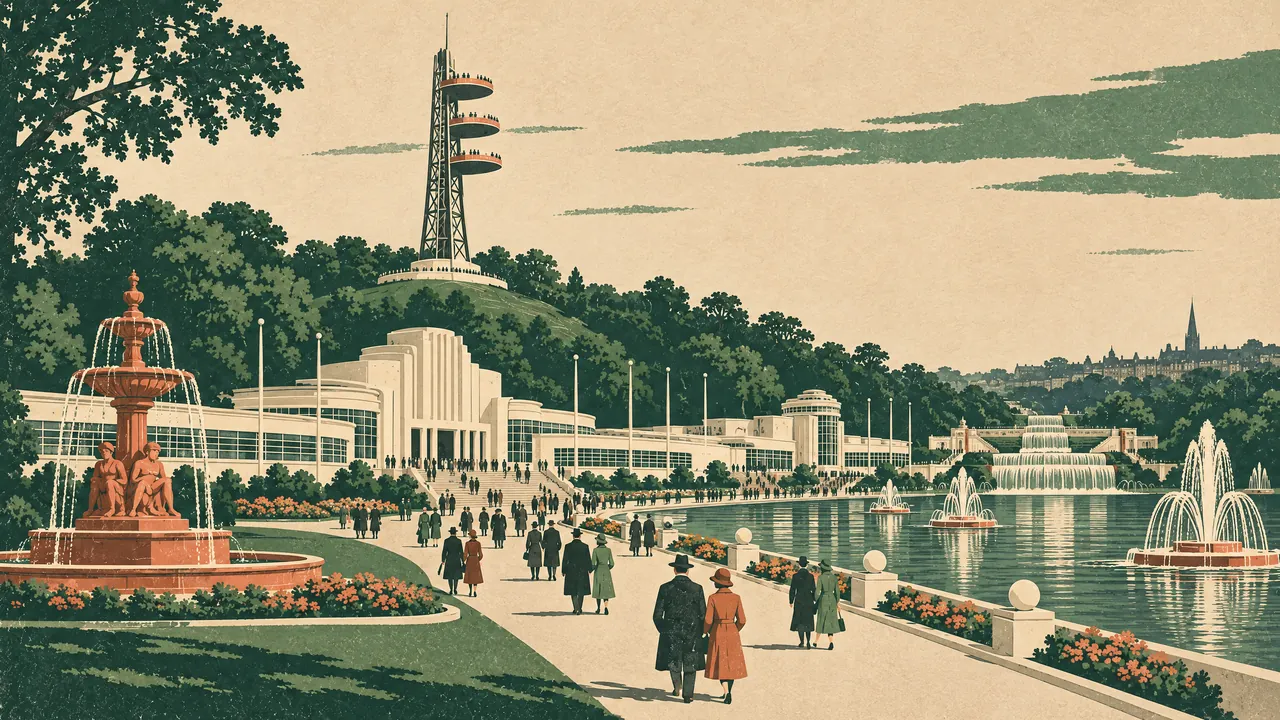
The Empire Exhibition was a huge international fair held in Bellahouston Park, on the south side of Glasgow, from 3 May to 29 October 1938. It was designed to boost Scotland’s economy after the Great Depression and to celebrate trade across the British Empire. Opened by King George VI and Queen Elizabeth, it drew 12.8 million visitors in six months, despite one of the wettest summers on record and being closed on Sundays. Its most famous landmark, the 300-foot Tait Tower, was demolished the following year.
Why was the Empire Exhibition held?
The 1930s had hit the west of Scotland hard. Shipbuilding, steel and engineering had all suffered during the Depression, and unemployment in Glasgow was high. The idea for an exhibition came from the Scottish Development Council, founded by the shipbuilder Sir James Lithgow, and was shaped by the Glasgow businessman Cecil Weir. It was officially launched at the Merchants House in Glasgow in October 1936.
Its stated aims were to show the progress of the British Empire, to encourage Scottish industry and Empire trade, to promote Scotland’s history and scenery to visitors, and to stress the peaceful aims of the Empire’s peoples at a time of rising tension in Europe. It also marked fifty years since Glasgow’s first great exhibition, the International Exhibition of 1888 in Kelvingrove Park, and it was the second British Empire Exhibition, following the one at Wembley in 1924 and 1925.
An Art Deco city in Bellahouston Park
Glasgow Corporation lent 145 acres of Bellahouston Park rent free. The master plan was drawn up by the Paisley-born architect Thomas S. Tait, who chose a bold modern Art Deco style and designed most of the hundred or so buildings himself. He was helped by a team of young Scottish architects, including Basil Spence, Jack Coia and Margaret Brodie. Built of steel and timber clad in panels, the whole exhibition went up in just ten months, a record for an international exhibition.
The largest buildings were the Palace of Engineering and the Palace of Industry. Countries across the Empire, including Canada, Australia, New Zealand, South Africa, Burma and Ireland, built their own national pavilions, and more than sixty companies put up pavilions of their own. There was a Scottish Avenue with pavilions celebrating Scotland’s history and industries, a Highland village or clachan, a Palace of Arts, three churches and a concert hall from which the BBC broadcast.
The Tait Tower
Crowning the hill at the centre of the park stood the Tower of Empire, popularly known as Tait’s Tower. It was 300 feet tall and, standing on the summit of the hill, rose about 470 feet above the surrounding ground. Lifts carried visitors to viewing platforms with views across the city and the Clyde valley. The tower could have been kept as a permanent monument, but it was handed over to the War Office after the exhibition and demolished in 1939. A popular story says it was pulled down so it could not guide German bombers, but that is a myth.
Fun, food and football
The exhibition was not all industry and trade. Billy Butlin, later famous for his holiday camps, ran a twelve-acre amusement park with a scenic railway and dozens of rides. Visitors could dine in nineteen restaurants, including one in the tower and the Atlantic Restaurant, built by the Anchor Line in the shape of an ocean liner’s bow. Floodlit dancing fountains, among the first of their kind, lit up the lakes at night.
Ibrox Stadium, next to the park, hosted the opening ceremony, attended by 146,000 people, and a programme of sporting events. An international football tournament for the Empire Exhibition Trophy brought together leading Scottish and English clubs, and it was won by Celtic, who beat Everton in the final.
What survives today?
Almost everything was temporary, but a few buildings live on. The Palace of Arts, built in brick and designed by Launcelot Ross, still stands in Bellahouston Park and is used as a sports and community facility. The granite commemoration stone unveiled by the King and Queen in 1937 remains on the hill. The Palace of Engineering was dismantled and rebuilt at Prestwick, where it became an aircraft factory and is still used by the aviation industry. The South Africa pavilion was moved to Ardeer in Ayrshire, and the Empire News Theatre became a cinema in Lochgilphead.
In the city centre, the Beresford Hotel on Sauchiehall Street, built to house exhibition visitors and often called Glasgow’s first skyscraper, survives as flats. And thanks to a digital reconstruction by the Glasgow School of Art, you can now explore the lost exhibition in 3D.
Related questions
Where was the Empire Exhibition held?
It was held in Bellahouston Park on the south side of Glasgow, with the opening ceremony and sports events at the neighbouring Ibrox Stadium.
How many people visited the 1938 Empire Exhibition?
About 12.8 million people visited between May and October 1938, despite one of the wettest summers on record.
What happened to the Tait Tower?
The 300-foot Tower of Empire was demolished in 1939. The story that it was removed to stop it guiding German bombers is a myth.
Are any Empire Exhibition buildings still standing?
Yes. The Palace of Arts survives in Bellahouston Park, the Palace of Engineering was moved to Prestwick, and the Beresford Hotel still stands on Sauchiehall Street.