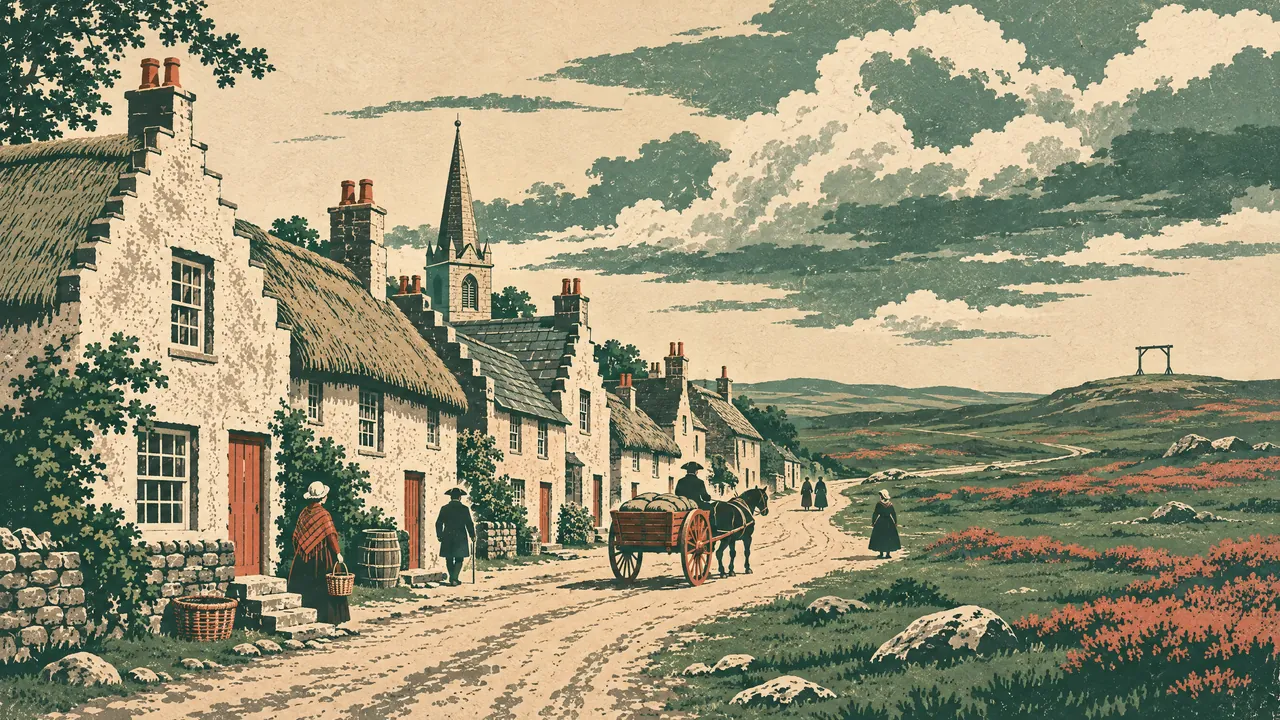
The Gallowgate is called the Gallowgate because it was the road to the gallows. In older Scots, a gate (or gait) meant a road or street, not a door or an entrance, so the name simply means the gallows road. In medieval and early modern Glasgow the street led east out of the town to an open common called the Gallowmuir, where the burgh’s gallows stood and public executions were carried out. As one nineteenth-century writer put it, the name meant Gallows-gate, or the road to the gallows.
What does “gate” mean in Glasgow street names?
The word gate in old street names comes from the Old Norse gata, meaning a road or way, which passed into Scots as gait. It has nothing to do with gates in a wall. You can see the same word all over northern England and Scotland: Newcastle and Aberdeen both have their own Gallowgate, and York has streets such as Stonegate and Micklegate.
In Glasgow the Gallowgate was one of the four ancient streets that met at Glasgow Cross, along with the High Street, the Trongate and the Saltmarket. Together they formed the heart of the medieval burgh. The Gallowgate was the main road heading east out of town, which is exactly where a town would put its place of execution: outside the built-up area, but on a busy route where everyone could see justice being done.
The Gallowmuir and Glasgow’s gallows
Old histories of the city describe how the Gallowgate ended in a common called the Gallowmuir, a stretch of rough open ground beyond the houses. The burgh’s place of execution stood there, and the gallows are said to have remained in the area until late in the eighteenth century. Records of the burgh also mention the Gallowmuir and a Gallowgate burn, a small stream that once crossed the road.
As Glasgow grew, executions moved closer to the centre. Hangings took place for a time at the Tolbooth at Glasgow Cross, and from the early nineteenth century public executions were held on Glasgow Green, outside the court buildings facing the river. The Gallowmuir itself was swallowed up by streets, mills and tenements as the East End expanded, but the name of the road that led to it stuck.
The Gallowgate through the centuries
For hundreds of years the Gallowgate was a busy commercial street lined with inns, shops and workshops. One of its most famous buildings was the Saracen Head Inn, opened in 1755 as one of the finest coaching inns in the city, which later welcomed visitors such as Samuel Johnson and James Boswell. The street gave its name to the Gallowgate Port, one of the old entrances into the burgh, and in the eighteenth and nineteenth centuries it became the gateway to the fast-growing industrial districts of Calton, Camlachie and Parkhead.
By the twentieth century the area around the eastern Gallowgate was one of the most densely populated parts of the city, packed with tenements, factories and breweries. Much of it was swept away in the slum clearances of the 1960s, when deck-access flats and the twin Bluevale and Whitevale tower blocks were built. The towers were taken down between 2014 and 2016, and new housing has since replaced many of the 1960s blocks.
The Gallowgate today
Today the Gallowgate is part of the A89, running from Glasgow Cross through the East End towards Parkhead. It passes the Barras market and the Barrowland Ballroom, and on match days it fills with football fans heading to Celtic Park. Its old pubs, including the Saracen Head, which carries on the name of the famous inn, still give the street a strong sense of history, even if few people walking it think about where the name came from.
The name is also used for the Gallowgate neighbourhood, a smaller area on the north side of the road between Bellgrove Street and Millerston Street.
Related questions
What does Gallowgate mean?
Gallowgate means the road to the gallows. Gate comes from the Scots gait and Old Norse gata, meaning a road or street, and the street led to the Gallowmuir, where Glasgow’s gallows once stood.
Were people hanged on the Gallowgate?
Executions took place at the Gallowmuir, the open common at the far end of the Gallowgate, rather than on the street itself. Later, hangings moved to Glasgow Cross and then to Glasgow Green.
Is the Gallowgate one of Glasgow’s oldest streets?
Yes. It is one of the four ancient streets that meet at Glasgow Cross, along with the High Street, the Trongate and the Saltmarket.
Why do Newcastle and Aberdeen also have a Gallowgate?
The same name was used in many towns for the road leading to the place of execution, because gate was the old northern word for a street.