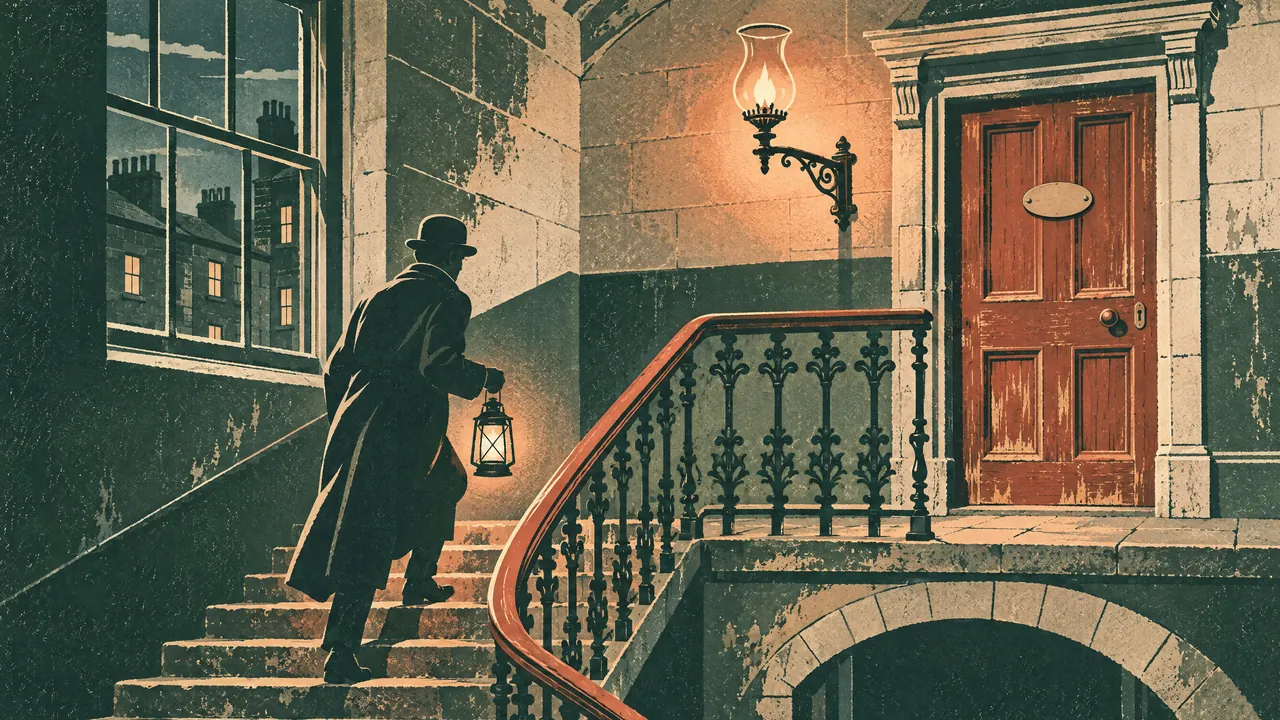
A ticketed house was a small Glasgow flat that had been officially measured and given a metal “ticket” on its door, showing its size in cubic feet and the maximum number of people allowed to sleep there. The system was designed to fight overcrowding and the disease it spread. Sanitary inspectors could enter at night to count the occupants, and landlords and tenants could be fined if there were too many. By the 1880s Glasgow had more than 23,000 ticketed houses, and the system lasted into the 1930s.
Why Glasgow introduced ticketing
In the middle of the nineteenth century Glasgow’s population was growing faster than the city could house it. Migrants from the Highlands, Ireland and the rest of Scotland poured in to work in the mills, shipyards and foundries, and they crammed into the old tenements of the city centre. Families of six or eight lived in a single room, and many households took in lodgers to help pay the rent.
Repeated epidemics of cholera and typhus killed thousands. The science was not yet fully understood, but city leaders were making the connection between overcrowding, dirt and disease. Until then the city’s building rules had mostly dealt with safety and the cleaning of shared closes. Now it began to regulate the number of people living inside each house.
How the ticket system worked
The key rule was set out in the Glasgow Police Act of 1862, and it was enforced more widely after the public health reforms of the mid-1860s, so some accounts date the system to 1866. Every small house that the authorities thought might become overcrowded was measured. In practice that meant dwellings of three rooms or fewer with a total volume of up to 2,000 cubic feet.
Officials worked out how much air each person needed, usually reckoned at 300 cubic feet for an adult, with young children counted at a lower rate. From that they calculated how many people could legally sleep in the house. Both figures, the cubic capacity and the permitted number of occupants, were stamped on an iron or enamel plate and fixed to the front door for all to see.
Night inspections
A ticket on its own changed nothing, so the city’s sanitary department employed night inspectors to check. They preferred to call between midnight and five in the morning, when everyone was at home and asleep and the doors were shut. If a house held more people than its ticket allowed, both the landlord and the tenant could be prosecuted and fined.
Tenants quickly learned to fight back. Peter Fyfe, Glasgow’s chief sanitary inspector, told a Royal Commission in 1915 that word spread along a street the moment the night men appeared, and by the time they reached the closes further on the residents were up and dressed. Inspectors found people hidden in every corner imaginable and, in one case recorded in the city archives, several family members squeezed between a bed and its mattress.
How big was the system?
By the 1880s there were 23,228 ticketed houses in Glasgow, officially sleeping around 75,000 people, about one seventh of the city’s population at the time. The real number living in them was certainly higher. Magistrates were often lenient with families crammed in with their own children, but those who packed in lodgers for profit could expect harsher treatment.
Photographs taken for the city show what a ticketed house looked like, including one in Bolton Street, now Ardgowan Place, with its small plate fixed beside the door.
Why the system ended
Ticketing tackled the symptom, not the cause. It could stop a room from holding too many people, but it could not create more homes for them to go to, and many families simply moved on to somewhere else that was just as crowded. The real change came with slum clearance and the building of new council housing in the twentieth century, which gradually replaced the worst of the old tenements. The ticketing system faded out in the 1930s, deeply unpopular to the end with the poorest Glaswegians, who had endured the indignity of being counted in their beds.
A few original tickets survive in museum and archive collections, small reminders of just how crowded Victorian Glasgow was.
Related questions
What was written on a ticketed house plate?
The metal ticket showed the size of the house in cubic feet and the maximum number of people allowed to sleep in it, worked out from the space each adult was thought to need.
When did ticketing start in Glasgow?
The rule was introduced in the Glasgow Police Act of 1862 and enforced more widely from the mid-1860s. Some sources date it to the City Improvement Act of 1866.
How many ticketed houses were there in Glasgow?
By the 1880s there were 23,228 ticketed houses, officially housing about 75,000 people, around one seventh of the city’s population.
When did ticketed houses end?
The system continued into the 1930s, when slum clearance and new council housing made it largely unnecessary.