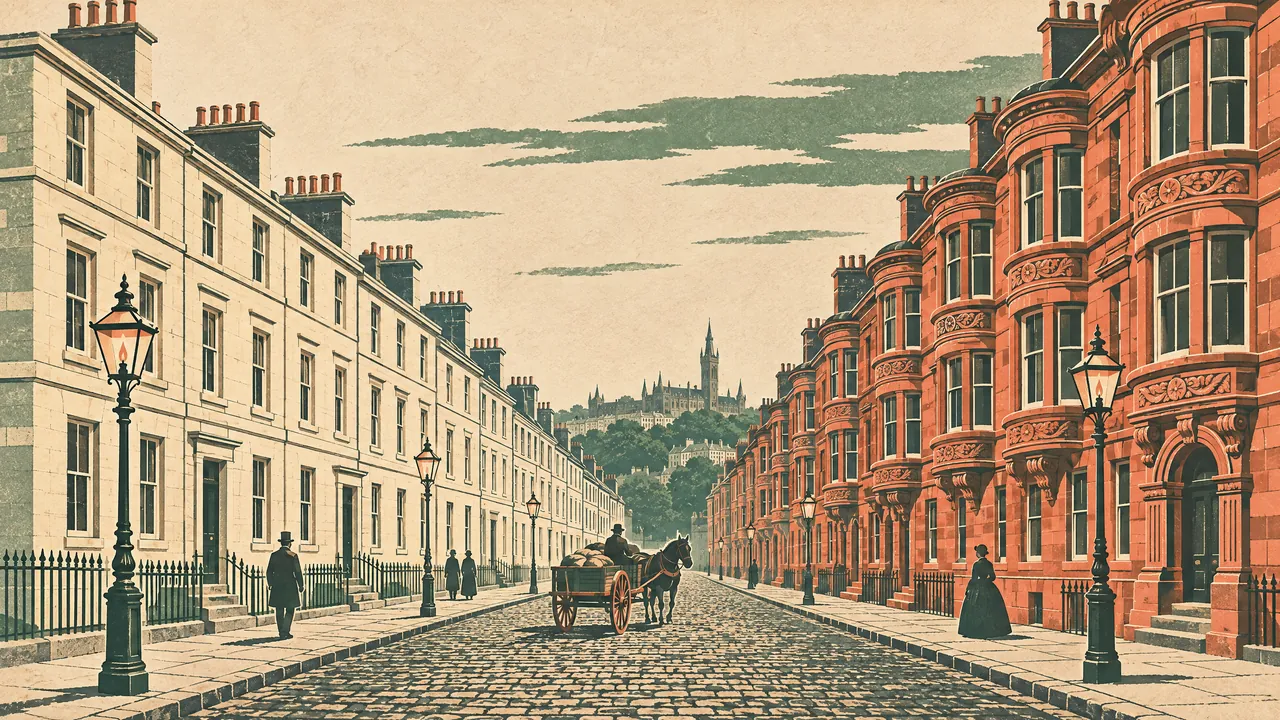
Glasgow’s tenements are red or blonde because they were built from two different types of sandstone, quarried in different places at different times. Most buildings put up before the 1890s used blonde sandstone from quarries in and around the city. As those local quarries were worked out, builders switched to cheaper red sandstone brought in by rail from Dumfriesshire and Ayrshire. As a rough rule, blonde stone means an older building and red stone means one from the late Victorian or Edwardian years.
Blonde sandstone: Glasgow’s local stone
Glasgow sits on rocks from the Carboniferous period, around 300 to 360 million years old. Among them are thick beds of pale, fine-grained sandstone, cream to yellow in colour, which was ideal for building. For most of the city’s history this was the stone that built Glasgow, from Georgian merchants’ houses to the long rows of Victorian tenements in districts such as the Merchant City, Laurieston and the early West End.
The stone was quarried locally, from sites at Giffnock and Bishopbriggs on the edge of the city and, earlier, from quarries close to what became Kelvingrove and Partick. Being close to hand, it was the obvious choice for builders in a fast-growing city.
Why builders switched to red sandstone
Glasgow grew so quickly in the nineteenth century that it used up its own building stone. By the later decades of the century the best and most accessible beds had been worked out. The surviving quarries could no longer be extended as open pits and had to follow the stone underground, using the slower and more expensive pillar-and-stall method more familiar from coal mining. Local stone became harder to get and more costly.
At the same time the railway network had reached the south of Scotland. Quarries in Dumfriesshire, such as Locharbriggs near Dumfries, and in Ayrshire could cut fresh red sandstone from new, easily worked faces and send it north by train. As the Glasgow politician Paul Sweeney pointed out in a widely shared explanation in 2020, the red stone was not necessarily better than the local blonde, but it was cheaper. From the 1890s onwards red sandstone became the fashionable choice for new tenements, shops, banks and public buildings.
What makes the stone red?
The colour comes from iron. The red sandstones of southern Scotland are younger rocks, laid down mainly in the Permian period, around 250 to 300 million years ago, when Scotland lay in a hot, dry desert. Iron minerals in the sand were oxidised, in effect rusted, which coated the grains with a reddish film. The blonde sandstones formed in different conditions and contain far less of this iron oxide, which is why they are so much paler.
Red sandstone is often described as harder wearing than many blonde stones, standing up better to Glasgow’s damp air and the soot of the industrial city, although the quality of any stone depends on the individual quarry.
How to read a Glasgow street
Once you know the story, the colours become a rough guide to dating Glasgow buildings. Pale stone tenements in older districts mostly date from before about 1890. Red sandstone tenements, with their bay windows and decorative details, mostly belong to the building boom of the 1890s and 1900s. Many of the city’s grandest red buildings come from this period, including Kelvingrove Art Gallery and Museum, opened in 1901 and built of red Locharbriggs sandstone.
Look round the back of some red tenements and you may get a surprise. Builders often saved money by using expensive red stone only on the street front and cheaper blonde stone, or brick, on the back walls facing the back court, where few people would see it.
Black, then clean again
For much of the twentieth century it was hard to tell the difference at all. Smoke from coal fires, factories and railways turned Glasgow’s sandstone almost black, and many people grew up thinking of the city as a dark, sooty place. Stone cleaning in the 1970s and 1980s, often paid for by grants to restore tenements, stripped back the grime and revealed the original colours again. Some cleaning methods damaged the stone, and today conservation experts take a gentler approach, but the result is the red and blonde city we see now.
Related questions
Is red or blonde sandstone older in Glasgow?
Blonde sandstone buildings are generally older. Local blonde stone was used for most buildings until the 1890s, when cheaper red sandstone from Dumfriesshire and Ayrshire took over.
Where did Glasgow’s red sandstone come from?
Most came by rail from quarries in Dumfriesshire, such as Locharbriggs near Dumfries, and from Ayrshire.
Why is red sandstone red?
Its colour comes from iron oxide coating the grains of sand, formed when the rock was laid down in desert conditions around 250 to 300 million years ago.
Why were Glasgow’s buildings black?
Decades of smoke from coal fires and industry blackened the sandstone. Stone cleaning from the 1970s onwards revealed the red and blonde colours again.