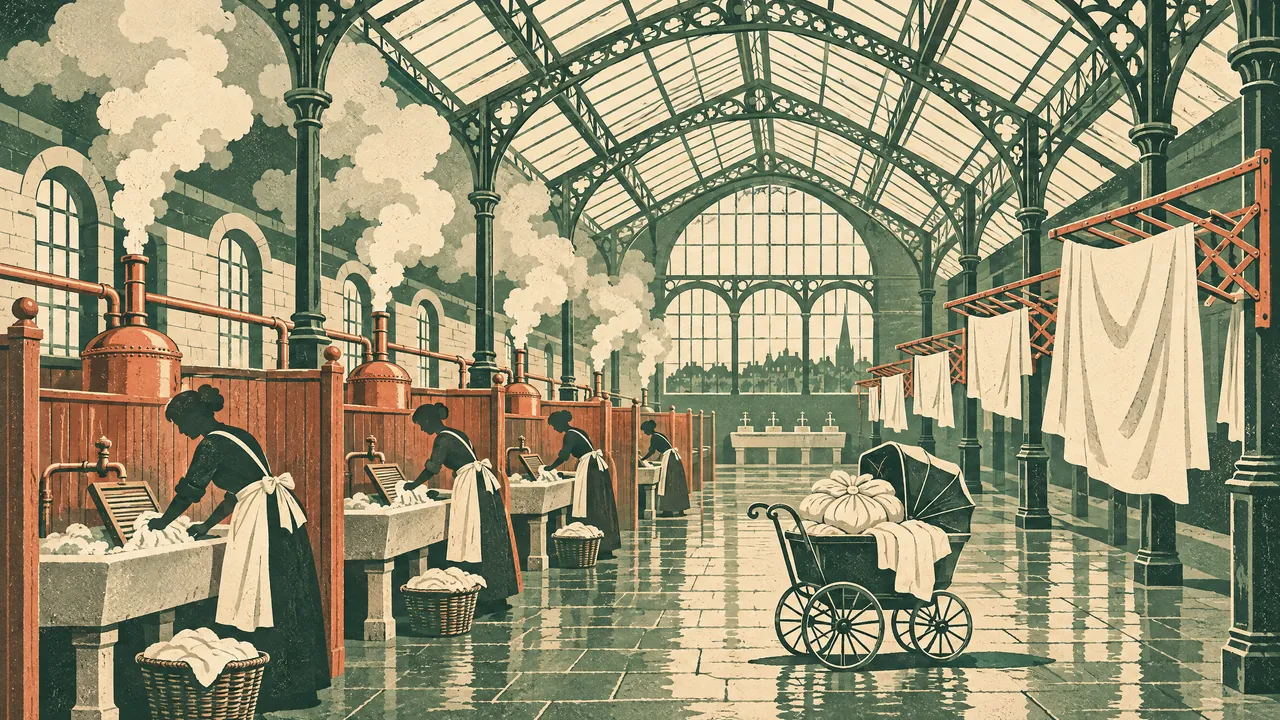
A steamie was a public wash-house, where people without a sink, hot water or space at home could wash, boil, mangle and dry their laundry for a small charge. The name comes from the clouds of steam that filled them. Glasgow Corporation opened its first municipal baths and wash-house, the Greenhead Baths on Glasgow Green, in 1878, and for the next hundred years the steamie was a central part of tenement life, especially for the women who did most of the washing.
Why Glasgow needed public wash-houses
By the middle of the nineteenth century Glasgow was one of the most overcrowded cities in Europe. Many families lived in one or two rooms in a tenement, often with no running water inside the house, let alone hot water. Washing sheets and clothes properly in a single end was close to impossible, and dirty linen and bedding helped spread diseases such as typhus and cholera.
Two changes made public wash-houses possible. The first was clean, plentiful water from Loch Katrine, which reached the city in 1859. The second was the City Improvement Act of 1866, which gave the Corporation new powers to tackle slums and public health. The city already had an old public wash-house on Glasgow Green, dating back to 1732, but it was knocked down in 1876 and replaced by something far more ambitious.
Greenhead and the first municipal steamie
The Greenhead Public Baths and Wash-House opened in 1878. It offered two swimming pools, 34 private baths and space for forty women to do their washing. Demand was so high that within months the Baths Committee was already discussing an extension. Within seven years four more Corporation baths and wash-houses had opened, at Woodside, Cranstonhill, Townhead and the Gorbals, and many more followed across the city over the next few decades.
The Corporation saw the steamies as a weapon against disease, and its superintendents hoped that children who came along with their mothers would grow up with what one report called habits of cleanliness. The great attraction for most people, though, was hot water on tap, something very few tenement flats had.
What happened inside a steamie
A trip to the steamie was hard physical work. Women hauled bundles of washing through the streets in prams, carts and old baby buggies, then paid for a stall and a set amount of time. Each stall had deep sinks with hot and cold water, a washboard and a boiler for whites. After scrubbing and rinsing, the washing went through a mangle or a spin dryer, and then into heated drying horses, pull-out racks that dried a load far faster than any tenement pulley.
Plenty of tenements had their own wash-house in the back court, but many women still preferred the steamie. A report from the baths superintendent noted that in a back court wash-house you might wait ages for water to boil, find there were no tubs and spend almost as much on coal as the steamie charged for everything. At the public wash-house it was all there and ready.
More than just washing
The steamie was also one of the great social spaces of working-class Glasgow. Neighbours caught up on news, swapped gossip, shared tea and helped each other with heavy sheets. Children played in the corners or waited outside while their mothers worked. For women who spent most of their lives at home, a few hours at the steamie was a chance to see friends and have a laugh, even in the heat and noise.
That world was captured in The Steamie, Tony Roper’s much-loved play about four women doing their washing on Hogmanay in a 1950s Glasgow wash-house. It premiered in Glasgow in 1987, was later televised and is still regularly revived and toured across Scotland.
Why the steamies closed
The decline came slowly. Slum clearance moved families out of the old tenements into new council houses with their own bathrooms and kitchens, and from the 1960s onwards more and more homes had a washing machine. By the 1980s the steamies were losing customers fast, and most were closed. Some of the old baths buildings survive, such as Govanhill Baths and the derelict Whitevale Baths in the East End, but the noisy, steamy wash-houses that once served every district have almost all gone.
They have not been forgotten. Mention the steamie to any older Glaswegian and you are likely to hear stories of wet washing, blistered hands and some of the best gossip in the city.
Related questions
Why was it called the steamie?
It was named after the clouds of steam from the boilers, hot sinks and drying horses that filled the wash-house. The word steamie became the everyday Glasgow name for any public wash-house.
When did the first steamie open in Glasgow?
Glasgow had a public wash-house on Glasgow Green from 1732, but the first municipal baths and wash-house, Greenhead, opened in 1878. It is often described as the city’s first steamie.
When did the steamies close?
Most closed during the 1970s and 1980s, as families moved to homes with their own facilities and washing machines became common.
What is The Steamie play about?
Tony Roper’s play The Steamie follows four women washing their laundry in a Glasgow wash-house on Hogmanay in the 1950s. It premiered in 1987 and remains one of Scotland’s best-loved plays.