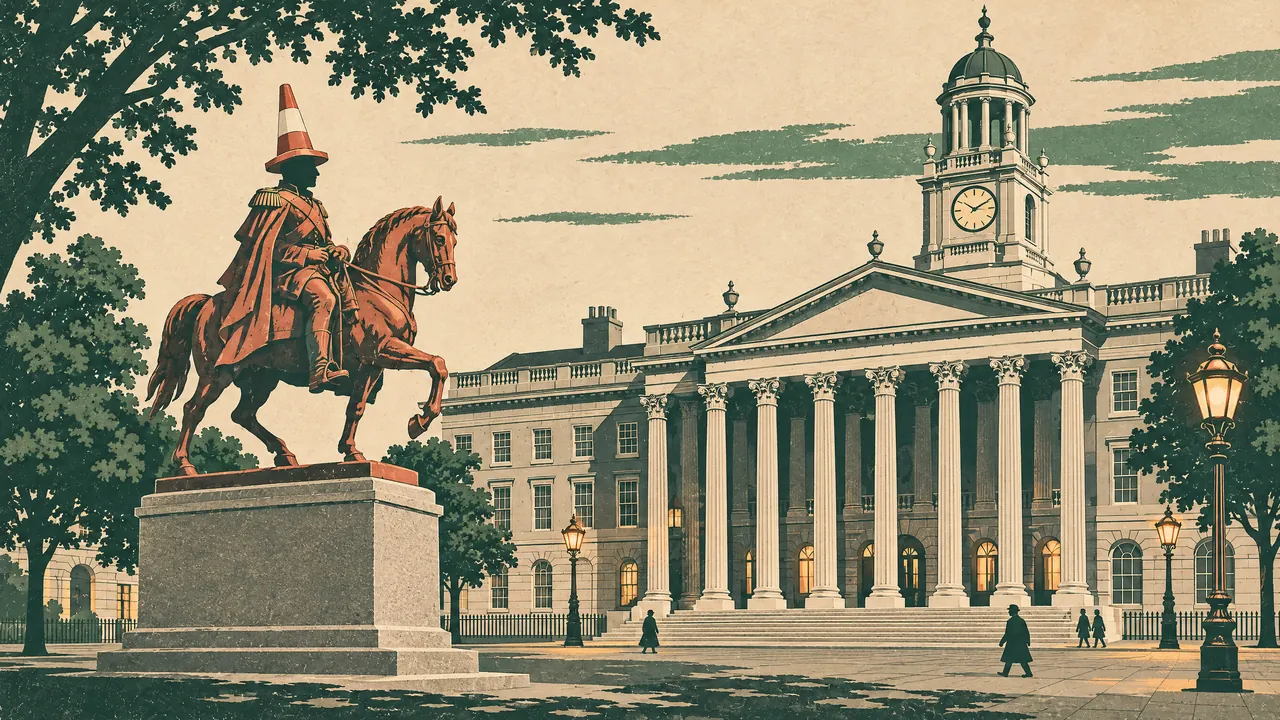
The Duke of Wellington statue in Glasgow has a traffic cone on his head because, since at least the 1980s, members of the public have climbed up and put one there, usually late at night. Every attempt to stop it has failed, and the cone has become a symbol of Glaswegian humour. The equestrian statue itself is a serious work of art: a bronze of Arthur Wellesley, 1st Duke of Wellington, by Carlo Marochetti, erected in 1844 outside what is now the Gallery of Modern Art in Royal Exchange Square.
The statue under the cone
A statue of Wellington was first proposed at a public meeting in Glasgow in 1840, a generation after his victory over Napoleon at the Battle of Waterloo in 1815. The money was raised by public subscription, with around 10,000 people contributing. The commission went to Carlo Marochetti, an Italian-born French sculptor, which caused some grumbling at the time from those who felt a British artist should have been chosen.
Marochetti cast the statue in France. It shows the Duke in the uniform of a field marshal, riding his favourite horse, Copenhagen, and stands on a plinth of Peterhead granite. Bronze relief panels on the sides show the Battle of Assaye in India and the Battle of Waterloo, while two smaller panels show a soldier returning home to peacetime work. Papers and medals sealed in crystal glass bottles were placed under the statue as a kind of time capsule.
The monument was unveiled on 8 October 1844 in front of a crowd of around 20,000 people, including 200 former soldiers who had served under Wellington. Today it is Category A listed, and it stands in front of the columns of the Gallery of Modern Art, the former Royal Exchange, at the Queen Street end of Royal Exchange Square in the city centre.
When did the cone first appear?
Nobody knows exactly who put the first traffic cone on the Duke’s head, or when. Photographs of the statue from the 1950s show no cone at all. The tradition is usually dated to the 1980s, and by the end of that decade a cone on the statue had become a familiar sight to anyone walking through the city centre. Most accounts put it down to students or late-night revellers on their way home, which is still the most likely explanation for most cones today.
What began as a prank stuck because it fitted the city’s sense of humour so well. Glasgow has always enjoyed taking the grand and the pompous down a peg, and a field marshal in a red and white traffic cone is a hard joke to beat.
Why has the council never stopped it?
Not for want of trying. In 2005 Glasgow City Council and Strathclyde Police asked the public to stop putting cones on the statue, warning that it caused minor damage and that people risked injury climbing up. It made no difference.
In 2013 the council proposed a £65,000 restoration scheme that included raising the plinth to roughly double its height, to deter all but the most determined climbers. Its planning papers estimated that removing cones cost about £100 a time, adding up to as much as £10,000 a year. The reaction was immediate. An online petition to keep the cone gathered more than 10,000 signatures, a rally was organised in its defence, and the council withdrew the plans. Whenever the cone has been removed, a new one has usually appeared within days.
Famous cones over the years
The plain red and white cone is the usual headgear, but the Duke has worn plenty of special editions. Some of the best known include:
- a gold cone in 2012, celebrating Scotland’s medal winners at the London Olympics, and again after the 2014 Commonwealth Games in Glasgow
- a “Yes” cone during the 2014 Scottish independence referendum campaign
- a cone painted with the flag of Europe on Brexit day in January 2020
- a face mask alongside the cone during the Covid-19 lockdowns
- a cone in the blue and yellow of Ukraine in March 2022
A replica of the statue, complete with cone, appeared at the opening ceremony of the 2014 Commonwealth Games, and when Glasgow hosted the Games again in 2026 its mascot, Finnie, was a unicorn with a traffic cone for a horn. During the 2026 World Cup, Scotland fans in Boston even put cones on statues there in tribute.
A landmark in its own right
The coned Duke now appears on postcards, tea towels and fridge magnets across the city, and Lonely Planet once listed it among the most bizarre monuments on Earth. In 2023, when Banksy staged an exhibition at the Gallery of Modern Art, he described the statue as his favourite work of art in the UK. For many visitors it is the first thing they want to see in Glasgow, and for locals it is a small, daily reminder that the city does not take itself too seriously.
Related questions
Where is the statue with the cone in Glasgow?
The Duke of Wellington statue stands in Royal Exchange Square in the city centre, in front of the Gallery of Modern Art and close to Queen Street. It is a short walk from George Square and Buchanan Street.
Who made the Duke of Wellington statue in Glasgow?
The statue was made by Carlo Marochetti, an Italian-born French sculptor, and unveiled on 8 October 1844. It shows the Duke on his horse Copenhagen and stands on a Peterhead granite plinth.
When did people start putting a cone on the statue?
The tradition is usually traced to the 1980s. Photographs from the 1950s show the statue without a cone, and by the late 1980s the coned Duke was a familiar city centre sight.
Is it illegal to put a cone on the Duke of Wellington statue?
The council and police have asked people not to do it, because climbing the statue is dangerous and can damage it. The tradition continues regardless, and the council has stopped short of measures such as raising the plinth.