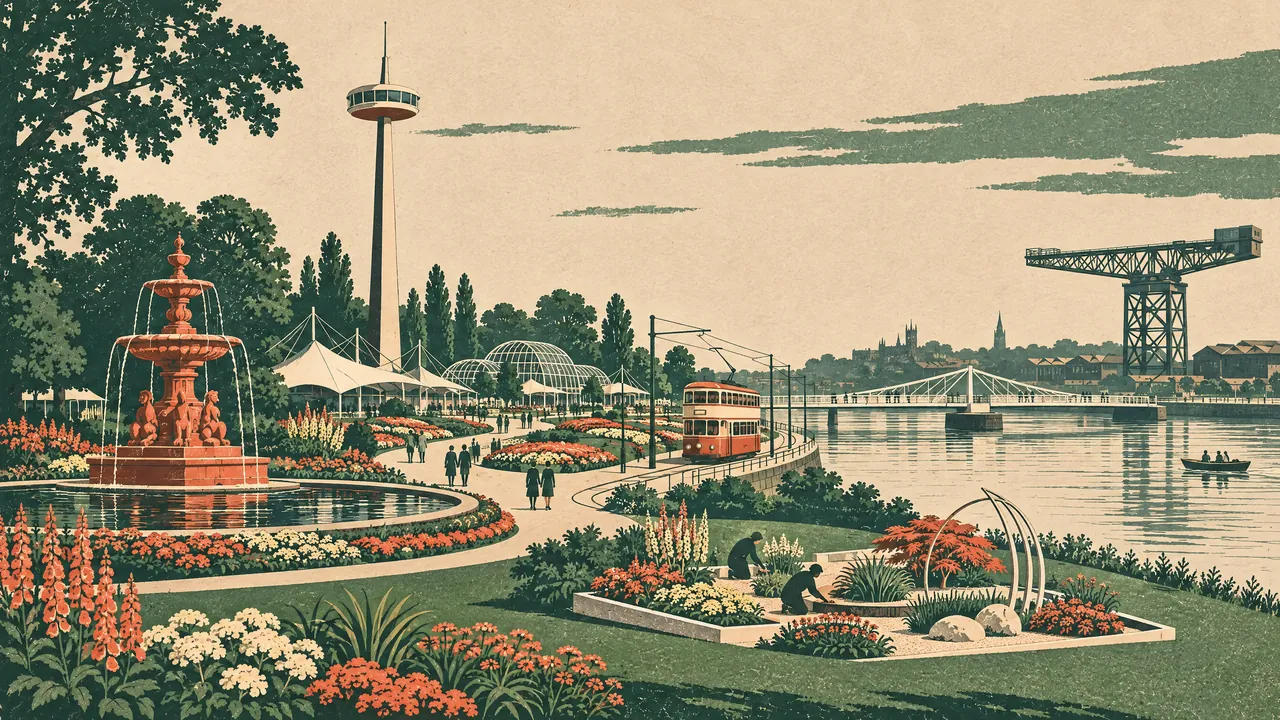
The Glasgow Garden Festival was a five-month event held on the south bank of the River Clyde at Plantation Quay, Govan, from 28 April to 26 September 1988. Built on derelict docklands, it mixed themed gardens with fairground rides, live entertainment and vintage trams, and it attracted 4.3 million visitors in 152 days. It was the third of Britain’s five National Garden Festivals, the only one held in Scotland and by far the most successful. Together with Glasgow’s year as European City of Culture in 1990, it helped transform the city’s image.
Why was the festival held?
The National Garden Festivals were a 1980s government idea for regenerating old industrial land. Each festival would reclaim a derelict site, turn it into gardens for a season and then leave it ready for new development. The first was held in Liverpool in 1984, followed by Stoke-on-Trent in 1986. After Glasgow came Gateshead in 1990 and Ebbw Vale in 1992.
Glasgow badly needed the boost. The decline of shipbuilding and heavy industry had left the river lined with empty docks and the city with a reputation for poverty and decay. The festival was the first event of its kind in Glasgow for fifty years, since the Empire Exhibition of 1938, and it also marked the centenary of the city’s first great exhibition in 1888.
The site at Plantation Quay
The festival covered 120 acres, including 17 acres of water, on the south bank of the Clyde opposite Finnieston. Much of it was built on the former Prince’s Dock, once the largest dock on the river when it opened in 1900, which had closed to shipping in the early 1970s as container ships took trade elsewhere. The basin was partly filled in to create the site.
The festival was designed and built by the Scottish Development Agency, which also created the Scottish Exhibition Centre on the old Queen’s Dock across the river. A new pedestrian swing bridge, Bell’s Bridge, was built to link the two. When it opened it was the longest pedestrian swing bridge in the world, and it is still one of the festival’s lasting legacies.
What was there to see?
The festival was much more than flower beds. Alongside dozens of show gardens and themed areas, visitors could enjoy:
- the Clydesdale Bank Tower, a 240-foot observation tower with sweeping views over the river and city
- the Coca-Cola Roller, a roller coaster that became one of the most popular attractions
- a miniature railway around the site
- five restored Glasgow Corporation trams, running along the riverside more than twenty-five years after the city’s last tram service ended
- concerts, street entertainers, boat trips and exhibitions, with a Grand International Show in the neighbouring exhibition centre
The festival was officially opened on 29 April 1988 by the Prince and Princess of Wales. It was covered daily on television, including the BBC gardening programme Beechgrove Garden, and the site even appeared as a backdrop in an episode of the detective drama Taggart.
What happened after the festival?
The plan was for the site to be developed straight away for homes, business and leisure, with a small festival park kept. In reality, most of the land sat empty for around a decade. Many Glaswegians who remember the magical summer of 1988 were disappointed to see the gardens disappear so quickly.
From the late 1990s the area was redeveloped and renamed Pacific Quay. The Glasgow Science Centre opened there in 2001, with the Glasgow Tower standing close to where the Clydesdale Bank Tower once stood. The festival tower itself was dismantled and rebuilt at Rhyl in North Wales. In 2007 BBC Scotland and STV both opened new headquarters at Pacific Quay, turning the old festival ground into the centre of Scottish broadcasting.
Remembering 1988
For many people who grew up in Glasgow in the 1980s, the Garden Festival is a treasured memory of long summer days, rides on the trams and the view from the tower. In 2018, its thirtieth anniversary was marked with exhibitions at the Mitchell Library and Kelvingrove, and a wildlife garden festival in the city. Its true legacy may be less in what it left on the ground than in the confidence it gave the city on the way to becoming European City of Culture.
Related questions
Where was the Glasgow Garden Festival held?
It was held at Plantation Quay in Govan, on the south bank of the Clyde, on the site now known as Pacific Quay, home to the Glasgow Science Centre and the BBC.
How many people visited the 1988 Garden Festival?
It attracted 4.3 million visitors over 152 days, making it the most successful of Britain’s five National Garden Festivals.
What happened to the Garden Festival tower?
The Clydesdale Bank Tower was dismantled after the festival and rebuilt at Rhyl in North Wales. The Glasgow Tower now stands close to its original spot.
Is anything left of the Glasgow Garden Festival?
Bell’s Bridge, built to link the festival with the exhibition centre, is the main survivor. The site itself became Pacific Quay.